


Page 76 - GHES-2-2
P. 76
Global Health Econ Sustain                                     Prevalence and risk factors of childhood diarrhea


              Spatial autocorrelation was employed to examine the   Table 1. Distribution of maternal and child, household, and
            clustering effect of diarrhea disease across India. Specifically,   environmental factors of the living children aged between 0
            the analysis of the spatial autocorrelation was prepared   and 59 months in rural India (NFHS‑5; 2019 – 21)
            through  Global  Moran’s  I  statistics  value  using  NFHS-5   Characteristics   Weighted percentage
            diarrhea disease occurrence within the last 2 weeks during the
            data collection. The Global Moran’s I statistics, along with   Overall diarrhea prevalence
            the  z-score and  p-value, were used to determine whether   Yes                                    7.3
            the distribution of diarrhea cases in Indian districts was   No                         92.7
            dispersed, random, or clustered. The Global Moran’s I value   Diarrhea prevalence
            ranges from +1 to −1, where a value close to +1 indicates a   Rural areas                          7.7
            clustered distribution and perfect positive autocorrelation,   Urban areas                         6.2
            and a value close to −1 indicates a dispersed distribution.   Maternal factors
            Whereas, a value close to 0 suggests a random distribution.
                                                                Maternal age (years)
              In  addition,  Getis_ord  or  GI*  statistics  were  utilized   15 – 24               30.1
            to identify the hot spots or cold spots of diarrhea cases
            within  Indian  districts.  Alongside  GI*  values,  z-scores   25 – 34                 59.9
            and p-values were computed to determine the statistical   35 – 49                                 10
            significance of these clusters. High Getis_ord or GI* values   Mother’s level of education
            indicate hot spot areas with a high proportion of diarrhea   No education               21.7
            cases, while low GI* values indicate cold spot areas with a   Primary                   12.9
            low proportion of diarrhea cases.                     Secondary and above               65.5
            3. Results                                         Children-related factors
                                                                Age group of children (years)
            3.1. Distribution of study participants in accordance   0 – 1                           38.7
            with different background characteristics
                                                                  2 – 3                                        40
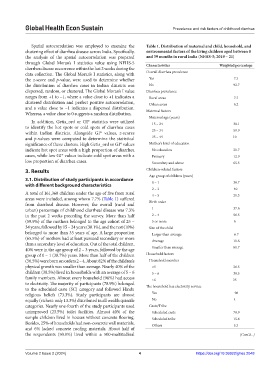
            A total of 161,368 children under the age of five from rural   4 – 5                    21.3
            areas were included, among whom 7.7% (Table 1) suffered
            from diarrheal disease. However, the overall (rural and   Birth order
            urban) percentage of childhood diarrheal disease was 7.3%   1                           37.6
            in  the  past  2  weeks  preceding  the  survey.  More  than  half   2 – 4              56.5
            (59.9%) of the mothers belonged to the age cohort of 25 –   5 or more                              6
            34 years, followed by 15 – 24 years (30.1%), and the rest (10%)   Size of the child
            belonged to more than 35 years of age. A large proportion   Larger than average          6.7
            (65.5%) of mothers had at least pursued secondary or more   Average                     11.6
            than a secondary level of education. Out of the total children,
            40% were in the age group of 2 – 3 years, followed by the age   Smaller than average    81.7
            group of 0 – 1 (38.7%) years. More than half of the children   Household factors
            (56.5%) were born on orders 2 – 4. About 82% of the children’s   Household member
            physical growth was smaller than average. Nearly 40% of the   <5                        26.5
            children (38.5%) lived in households with an average of 5 – 6   5 – 6                   38.5
            family members. Almost every household (96%) had access   >6                                      35
            to electricity. The majority of participants (78.9%) belonged   The household has electricity service
            to the scheduled caste (SC) category and followed Hindu
            religious beliefs  (73.3%). Study  participants  are almost   Yes                        96
            equally (richest: only 13.3%) distributed in all wealth quintile   No                              4
            categories. Nearly one-fourth of the study participants used   Caste/Tribe
            unimproved  (23.5%)  toilet  facilities.  Almost  40%  of  the   Scheduled caste        78.9
            sample children lived in houses without concrete flooring.   Scheduled tribe            15.8
            Besides, 25% of households had non-concrete wall materials,   Others                               5.3
            and 6% lacked concrete roofing materials. About half of
            the respondents (50.9%) lived within a 500-maltitudinal                                    (Cont’d...)


            Volume 2 Issue 2 (2024)                         4                        https://doi.org/10.36922/ghes.2048

