


Page 78 - GHES-2-2
P. 78
Global Health Econ Sustain                                     Prevalence and risk factors of childhood diarrhea


            Table 2. (Continued)
            Characteristics             Rural (N=161,368)
                                     Diarrhea   χ  (p‑value)
                                                 2
                                   prevalence (%)
             Wealth quintile
               Poorest                        7.8  142.040 (0.000)
               Poorer                         7.3
               Middle                         6.8
               Richer                         6.3
               Richest                        5.1
            Environmental factors
             Type of toilet facility
               Improved                       6.7  91.380 (0.000)
               Unimproved                     8.1
             Floor material
               Concrete                       6.7  33.022 (0.000)
               Not concrete                   7.5
             Wall material
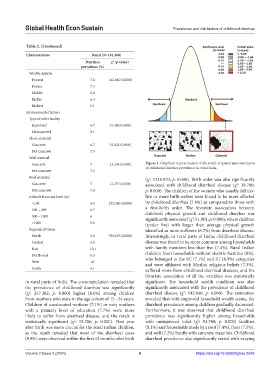
               Concrete                       7  13.234 (0.040)  Figure 1. Graphical representation of the result of spatial autocorrelation
                                                               of childhood diarrhea prevalence in rural India.
               Not concrete                   7.2
             Roof material
                                                               (χ : 1218.970; p: 0.000). Birth order was also significantly
                                                                2
               Concrete                       7  11.257 (0.030)  associated with childhood diarrheal disease (χ :  38.700;
                                                                                                      2
               Not concrete                   7.4              p: 0.000). The children of the women who usually fall into
             Altitude from sea level (m)                       five or more birth orders were found to be more affected
               <100                           6.5  232.960 (0.000)  by childhood diarrhea (7.4%) as compared to those with
               100 – 499                      6.7              a  first-birth  order. The  bivariate  association between
               500 – 1000                     6                children’s physical growth and childhood diarrhea was
                                                               significantly associated (χ : 51.901; p: 0.000), where children
                                                                                   2
               >1000                          8.6              (under five) with larger than average physical growth
             Regional division                                 identified as more sufferers (8.7%) from diarrheal disease.
               North                          5.6  938.676 (0.000)  Interestingly, in rural parts of India, childhood diarrheal
               Central                        5.6              disease was found to be more common among households
               East                    10.1                    with family members less than five (7.4%). Rural Indian
               North-east                     6.3              children from households without electric facilities (8%),
               West                           10               who belonged to the SC (7.1%) and ST (6.9%) categories
                                                               and were affiliated with Muslim religious beliefs (7.3%),
               South                          6.1              suffered more from childhood diarrheal diseases, and the
                                                               bivariate  association  of  all  the  variables  was  statistically
            in rural parts of India. The cross-tabulation revealed that   significant. The household wealth condition was also
            the prevalence of childhood diarrhea was significantly   significantly associated with the prevalence of childhood
             2
            (χ :  257.382;  p:  0.000)  higher  (8.6%)  among  children   diarrheal disease (χ :  142.040;  p: 0.000). The estimation
                                                                               2
            from mothers who were in the age cohort of 15 –24 years.   revealed that with improved household wealth status, the
            Children of uneducated mothers (7.1%) or only mothers   diarrheal prevalence among children gradually decreased.
            with a primary level of education (7.7%) were more   Furthermore, it  was observed that childhood diarrheal
            likely to suffer from diarrheal disease, and the result is   prevalence was significantly higher among households
                                                                                     2
            statistically significant (χ :  15.256;  p: 0.000). First year   with unimproved toilet (χ :  91.380;  p: 0.000) facilities
                                 2
            after birth was more crucial for the rural Indian children,   (8.1%) and households made by a roof (7.4%), floor (7.5%),
            as the result revealed that most of the diarrheal cases   and wall (7.2%) hardly with concrete materials. Childhood
            (9.8%) were observed within the first 12 months after birth   diarrheal prevalence also significantly varied with varying

            Volume 2 Issue 2 (2024)                         6                        https://doi.org/10.36922/ghes.2048

