


Page 80 - GHES-2-2
P. 80
Global Health Econ Sustain                                     Prevalence and risk factors of childhood diarrhea


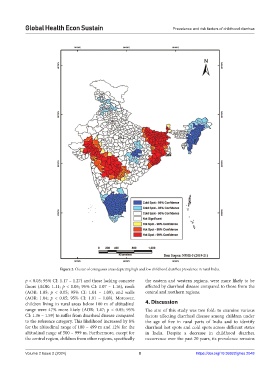
                           Figure 2. Cluster of contiguous areas depicting high and low childhood diarrhea prevalence in rural India.

            p < 0.05; 95% CI: 1.17 – 1.27) and those lacking concrete   the eastern and western regions, were more likely to be
            floors (AOR: 1.11; p < 0.05; 95% CI: 1.07 – 1.16), roofs   affected by diarrheal disease compared to those from the
            (AOR: 1.05;  p  < 0.05; 95% CI: 1.01 – 1.09), and walls   central and northern regions.
            (AOR:  1.04;  p  < 0.05; 95% CI:  1.01 – 1.08). Moreover,
            children living in rural areas below 100 m of altitudinal   4. Discussion
            range were 47% more likely (AOR: 1.47;  p  < 0.05; 95%   The aim of this study was two fold: to examine various
            CI: 1.36 – 1.59) to suffer from diarrheal disease compared   factors affecting diarrheal disease among children under
            to the reference category. This likelihood increased by 8%   the age of five in rural parts of India and to identify
            for the altitudinal range of 100 – 499 m and 12% for the   diarrheal hot spots and cold spots across different states
            altitudinal range of 500 – 999 m. Furthermore, except for   in India. Despite a decrease in childhood diarrhea
            the central region, children from other regions, specifically   occurrence over the past 20 years, its prevalence remains


            Volume 2 Issue 2 (2024)                         8                        https://doi.org/10.36922/ghes.2048

