


Page 146 - GHES-2-4
P. 146
Global Health Economics and
            Sustainability
                                                                                    Silver economy and long-term care


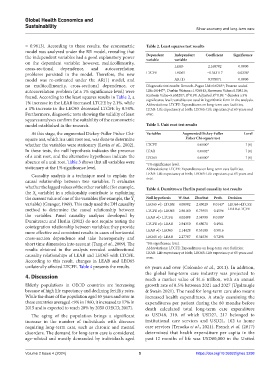
            = 0.9613). According to these results, the econometric   Table 2. Least squares test results
            model was analyzed under the RE model, revealing that
            the independent variables had a good explanatory power   Dependent   Independent   Coefficient  Significance
                                                               variable
                                                                           variable
            on the dependent variable; however, multicollinearity,
            cross-sectional  dependence,  and  autocorrelation             LEAB           2.168702    0.0000
            problems persisted in the model. Therefore, the new   LTCFE    LEO65         −0.543117    0.0338*
            model  was  re-estimated  under  the  AR(1)  model,  and       AR (1)         0.978071    0.0000
            no multicollinearity, cross-sectional dependence, or   Diagnostic test results: Breusch–Pagan LM=0.0265*; Pesaran scaled
            autocorrelation problem (at a 1% significance level) were   LM=0.0447*; Durbin Watson=1.926913; Skewness Value=0.508116;
                                                                                 2=
                                                                                            2=
            found. According to the least squares results in Table 2, a   Kurtosis Value=5.658287; R 0.99; Adjusted R 0.99. * denotes a 5%
                                                               significance level; variables are used in logarithmic form in the analysis.
            1% increase in the LEAB increased LTCFE by 2.1%, while   Abbreviations: LTCFE: Expenditures on long-term care facilities;
            a 1% increase in the LEO65 decreased LTCFE by 0.54%.   LEAB: Life expectancy at birth; LEO65: Life expectancy at 65 years and
            Furthermore, diagnostic tests showing the validity of least   over.
            squares analyses confirm the suitability of the econometric
            model established in the research.                 Table 3. Unit root test results
              At this stage, the augmented Dickey-Fuller Fisher Chi-  Variables  Augmented Dickey‑Fuller   Level
            square test, which is a unit root test, was done to determine       Fisher Chi‑square test
            whether the variables were stationary (Levin et al., 2002).   LTCFE      0.0000*             I (0)
            In these tests, the null hypothesis indicates the presence   LEAB        0.0002*             I (0)
            of a unit root, and the alternative hypotheses indicate the   LEO65      0.0000*             I (0)
            absence of a unit root. Table 3 shows that all variables were   *1% significance level.
            stationary at the 1% significance level.           Abbreviations: LTCFE: Expenditures on long-term care facilities;
              Causality analysis is a technique used to explain the   LEAB: Life expectancy at birth; LEO65: Life expectancy at 65 years and
            causal relationship between two variables. It evaluates   over.
            whether the lagged values of the other variable (for example,   Table 4. Dumitrescu Hurlin panel causality test results
            the X variable) in a relationship contribute to explaining
                t
            the current value of one of the variables (for example, the Y t   Null hypothesis  W‑Stat.  ZbarStat  Prob.  Decision
            variable) (Granger, 1969). This study used the DH causality   LEO65 ≠|> LTCFE  4.08902  2.45029  0.0143* LEO65→LTCFE
            method to determine the causal relationship between   LTCFE ≠|> LEO65  2.98160  0.73955  0.4596  LEAB→LTCFE
            the variables. Panel causality analyses developed by   LEAB ≠|> LTCFE  4.02408  2.34998  0.0188*
            Dumitrescu and Hurlin (2012) do not require testing the   LTCFE ≠|> LEAB  2.94350  0.68071  0.4961
            cointegration relationship between variables; they provide
            more effective and consistent results in cases of horizontal   LEAB ≠|> LEO65  2.14428  0.55108  0.5816
            cross-section dependence and take heterogeneity and   LEO65 ≠|> LEAB  2.27707  0.34536  0.7298
            short time dimension into account (Tang et al., 2009). The   *5% significance level.
            results obtained in the analysis revealed unidirectional   Abbreviations: LTCFE: Expenditures on long-term care facilities;
            causality relationships of LEAB and LEO65 with LTCFE.   LEAB: Life expectancy at birth; LEO65: Life expectancy at 65 years and
                                                               over.
            According to this result, changes in LEAB and LEO65
            unilaterally affected LTCFE. Table 4 presents the results.  65 years and over (Colombo et al., 2011). In addition,
                                                               the global long-term care industry was projected to
            4. Discussion                                      reach a market value of $1.6 trillion, with an annual
            Elderly populations in  OECD countries  are increasing   growth rate of 8.5% between 2021 and 2027 (Ugalmugle
            because of high life expectancy and declining fertility rates.   & Swain 2021). The need for long-term care also means
            While the share of the population aged 65 years and over in   increased health expenditures. A  study examining the
            these countries averaged <9% in 1960, it increased to 17% in   expenditures per patient during the 60 months before
            2015 and is expected to reach 28% by 2050 (OECD, 2017).  death calculated total long-term care expenditure
              The aging of the population brings a significant   as USD48, 319, of which USD27, 217 belonged to
            increase in the number of individuals with diseases   institutional  care  services  and  USD21,  102  to  home
            requiring long-term care, such as chronic and mental   care services (Teraoka et al., 2021). French et al. (2017)
            disorders. The demand for long-term care is considered   determined that health expenditure per capita in the
            age-related and mostly demanded by individuals aged   past 12  months of life was USD80,000 in the United


            Volume 2 Issue 4 (2024)                         5                        https://doi.org/10.36922/ghes.3298

