


Page 147 - GHES-3-2
P. 147
Global Health Economics and
            Sustainability
                                                                             Vaccine hesitancy in the US, India, and China


            (i)  What is the level of vaccine hesitancy among the three   BLR. The theory behind MLR includes the following key
               largest countries by population size: the US, India, and   components:
               China?
            (ii)  What factors are associated with vaccine hesitancy in   3.1.1. Logistic regression
               these countries?                                The MLR builds on the principles of BLR. The BLR models
            (iii) How can cross-sectional and longitudinal data be   the relationship between a set of predictor variables and
               utilized to study vaccine hesitancy?            a binary outcome variable. It uses the logistic function
            (iv)  Which subgroups require further research on vaccine   to estimate the probability of the outcome being in one
               hesitancy?                                      category versus the other. In MLR, this concept is extended

              To address these questions, we analyze two datasets   to multiple outcome categories.
            on vaccine hesitancy. The first dataset is extracted from   3.1.2. Categorical outcome variable
            the ICPSR COVID-19 database (https://doi.org/10.3886/
            E130422V1) and includes cross-sectional survey data   In  MLR,  the  outcome  variable  is categorical, with  three
            assessing the prevalence of vaccine hesitancy in the US,   or more unordered categories. Each category represents a
            India, and China. The second dataset is derived from the   distinct and mutually exclusive outcome. Examples could
            HPS data.                                          include predicting the choice of a political party (e.g.,
                                                               democrat, republican, and independent) or predicting the
              For the ICPSR dataset, we report proportions and   type of vehicle chosen (e.g., car, truck, SUV).
            summary statistics to give an overview of the vaccine
            hesitancy global picture. The HPS dataset was analyzed   3.1.3. Logits and log odds
            using multinomial and binary logistic regression. When   The probabilities of each category are modeled as the log
            the response or outcome can be categorized into two   odds (logit) of being in that category (Equations I and II).
            classes, such as “Hesitant” and “Not hesitant,” and with   The log odds represent the natural logarithm of the ratio
            several explanatory variables, then a BLR is commonly   of  the  probability  of  being  in a  specific  category  to  the
            used. If there are more than two categories, then a natural   probability of being in a reference category. The reference
            extension of BLR is MLR. Individual Chi-square tests   category is one of the categories used as the baseline for
            of independence between vaccine hesitancy and health   comparison.
            categories and exploratory data analysis supplemented
            and helped in our understanding of the causal factors   3.1.4. Parameter estimation
            influencing vaccine  hesitancy.  Rstudio (RStudio|Open
            Source & Professional Software for Data Science Teams-  The estimates of the parameters of an MLR model are
            RStudio, n.d.) and Microsoft Excel were utilized for the   obtained using maximum likelihood estimation. The goal
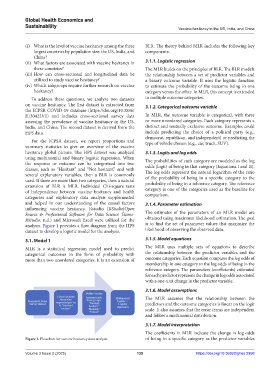
            analysis. Figure 1 provides a flow diagram from the HPS   is to find the set of parameter values that maximize the
            dataset to develop a logistic model for the analysis.  likelihood of observing the observed data.
            3.1. Model 1                                       3.1.5. Model equations
            MLR is a statistical regression model used to predict   The MLR uses multiple sets of equations to describe
            categorical  outcomes  in  the  form  of  probability  with   the relationship between the predictor variables and the
            more than two unordered categories. It is an extension of   outcome categories. Each equation compares the log odds of
                                                               membership in one category to the log odds of being in the
                                                               reference category. The parameters (coefficients) estimated
                                                               for each predictor represent the change in log odds associated
                                                               with a one-unit change in the predictor variable.
                                                               3.1.6. Model assumptions
                                                               The MLR assumes that the relationship between the
                                                               predictors and the outcome categories is linear on the logit
                                                               scale. It also assumes that the error terms are independent
                                                               and follow a multinomial distribution.

                                                               3.1.7. Model interpretation
                                                               The coefficients in MLR indicate the change in log odds
            Figure 1. Flowchart for vaccine hesitancy data analysis  of being in a specific category as the predictor variables


            Volume 3 Issue 2 (2025)                        139                       https://doi.org/10.36922/ghes.2958

