


Page 152 - GHES-3-2
P. 152
Global Health Economics and
            Sustainability
                                                                             Vaccine hesitancy in the US, India, and China


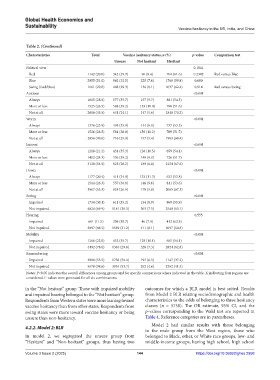
            Table 2. (Continued)
            Characteristics             Total        Vaccine hesitancy status, n (%)  p‑value  Comparison test
                                                  Unsure   Not hesitant  Hesitant
            Political view                                                         0.1841
             Red                      1142 (20.0)  342 (29.9)  96 (8.4)  704 (61.6)  0.2382  Red versus Blue
             Blue                     2955 (51.0)  962 (32.5)  225 (7.6)  1768 (59.8)  0.080
             Swing (Red/blue)         1661 (29.0)  488 (29.3)  136 (8.1)  1037 (62.4)  0.914  Red versus Swing
            Anxious                                                                <0.001
             Always                   1615 (28.0)  577 (35.7)  157 (9.7)  881 (54.5)
             More or less             1525 (26.5)  584 (38.2)  153 (10.0)  788 (51.6)
             Not at all               2618 (45.5)  631 (24.1)  147 (5.6)  1840 (70.2)
            Worry                                                                  <0.001
             Always                   1376 (23.9)  495 (35.9)  144 (0.0)  737 (53.5)
             More or less             1526 (26.5)  581 (38.0)  156 (10.2)  789 (51.7)
             Not at all               2856 (49.6)  716 (25.0)  157 (5.4)  1983 (69.4)
            Interest                                                               <0.001
             Always                   1218 (21.2)  431 (35.3)  128 (10.5)  659 (54.1)
             More or less             1402 (24.3)  536 (38.2)  140 (9.9)  726 (51.7)
             Not at all               3138 (54.5)  825 (26.2)  189 (6.0)  2124 (67.6)
            Down                                                                   <0.001
             Always                   1177 (20.4)  411 (34.9)  133 (11.3)  633 (53.8)
             More or less             1514 (26.3)  557 (36.8)  146 (9.6)  811 (53.6)
             Not at all               3067 (53.3)  824 (26.9)  178 (5.8)  2065 (67.3)
            Seeing                                                                 <0.001
             Impaired                 1734 (30.1)  611 (35.2)  154 (8.9)  969 (55.9)
             Not impaired             4024 (69.9)  1181 (29.3)  303 (7.5)  2540 (63.1)
            Hearing                                                                 0.555
             Impaired                  661 (11.5)  203 (30.7)  46 (7.0)  412 (62.3)
             Not impaired             5097 (88.5)  1589 (31.2)  411 (8.1)  3097 (60.8)
            Mobility                                                               <0.001
             Impaired                 1266 (22.0)  452 (35.7)  129 (10.1)  685 (54.1)
             Not impaired             4492 (78.0)  1340 (29.8)  328 (7.3)  2824 (62.8)
            Remembering                                                            <0.001
             Impaired                 3080 (53.5)  1738 (56.4)  195 (6.3)  1147 (37.2)
             Not impaired             5678 (98.6)  3054 (53.7)  262 (4.6)  2362 (41.5)
            Notes: P<0.05 indicates the overall differences among groups and for specific comparisons where indicated in the table. X indicating four regions are
            considered. P-values were generated for all six combinations.

            in the “Not hesitant” group. Those with impaired mobility   outcomes for which a BLR model is best suited. Results
            and impaired hearing belonged to the “Not hesitant” group.   from Model 2 BLR relating sociodemographic and health
            Respondents from Western states were more leaning toward   characteristics to the odds of belonging to three hesitancy
            vaccine hesitancy than from other states. Respondents from   classes (n  = 5758). The OR estimate, 95% CI, and the
            swing states were more toward vaccine hesitancy or being   p-values  corresponding  to  the Wald test are  reported in
            unsure than non-hesitancy.                         Table 4. Reference categories are in parentheses.
                                                                 Model 2 had similar results with those belonging
            4.2.2. Model 2: BLR
                                                               to the male group from the West region, those who
            In model 2, we segregated the unsure group from    belonged to Black, other, or White race groups, low- and
            “Hesitant” and “Non-hesitant” groups, thus having two   middle-income groups, having high school, high school

            Volume 3 Issue 2 (2025)                        144                       https://doi.org/10.36922/ghes.2958

