


Page 149 - GHES-3-2
P. 149
Global Health Economics and
            Sustainability
                                                                             Vaccine hesitancy in the US, India, and China


            3.4.1.2. Ridge regression                          group. The income categories were redefined as follows:
            Ridge assigns the L2 penalty, which is the squared magnitude   “low-income group” for total household income <US$
            of the overemphasized coefficients, with λ determining the   34,999, “middle-income group” for incomes between US$
            weight assigned to the penalty. The larger the value of λ, the   34,999 and 74,999, and “high-income group” for those
            more likely the coefficients approach zero, but the L2 penalty   earning more than US$ 75,000. The education categories
            does not help in finding the optimum estimates. Unlike   were reclassified into: (i) “High school” (including less
            LASSO, the Ridge model will not shrink these coefficients to   than high school and some high school), (ii) “High school
            precisely zero. The likelihood is represented by Equation VII:  graduate” (high school graduate or equivalent), (iii) “some
                                                               college, no degree received,” (iv) “Associate/bachelor’s
            l    n i1 [ y x   log1  e x i  )]     p j1  2 j  (VII)  degree,” and (v) “Graduate degree.” The responses related
             R
                                (

                                                               to depression factors, such as frequency of anxiety, worry,
                        i

                          i
                                                               interest, and feeling down for over 2 weeks, were regrouped
              Here, β  is the L2 penalty. It uses the L2 penalty. The   into  three  categories:  “Not at  all,” “Several  days,”  and
                     2
            L2 penalty does not induce sparsity. With sparsity, one   “Always,” which includes responses for “More than half the
            can perform variable selection and also provide a level of   days” and “Nearly every day.” Other forms of impairment,
            interpretability of parameters.                    such as hearing, seeing, remembering, and mobility, were
                                                               also included and recategorized as “Impaired” (including
            3.4.1.3. Elastic net
                                                               some difficulty, a lot of difficulty, and cannot do at all) and
            Elastic net is a convex combination of LASSO and Ridge,   “Not impaired” (no difficulty). In addition to the selected
            with the effectual reduction in the effect of coefficients with   factors for investigation in the MLR model to understand
            L2 norm and exactly setting some coefficients to zero with   their  impact  toward  vaccine  hesitancy,  we  also  included
            L1 norm. The likelihood is represented by Equation VIII:  the  following  variables:  race  (White,  Black,  and  others);
                                                               gender (male, female, and transgender); health insurance
                   2
              p j1  1(  )  p j1   |  j |   (VIII)    status (yes, no); whether respondents received MH services
                   j
                                                               (yes, no); whether MH medicines (psychopharmacological
              Here,  λ is the penalty as a mixture of the previous   drugs) were prescribed (yes, no); and region (Midwest,
            two approaches. With the L1 norm, some regression   Northeast, South, and West). Analysis indicated that
            coefficients can be set to zero, thereby decreasing the   individuals in the Midwest and West regions  seemed
            number of parameters, and hence, it is not surprising that it   to be more vaccine-hesitant than those in the Northeast
            can outperform LASSO on data with positively correlated   or South. Furthermore, these regions were divided by
            variables.                                         topography into eight regions: West, Northwest, Midwest,
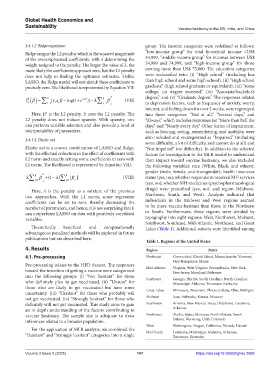
                                                               Southwest, Southeast, Mid-Atlantic, Northeast, and Great
              Theoretically  beneficial  and  computationally  Lakes (Table 1). Additional subsets were identified among
            advantageous penalized methods will be explored in future
            publications but are described here.
                                                               Table 1. Regions of the United States
            4. Results                                         Region                     States
            4.1. Pre-processing                                Northeast   Connecticut, Rhode Island, Massachusetts, Vermont,
                                                                           New Hampshire, Maine
            Pre-processing relates to the HPD dataset. The responses
            toward the intention of getting a vaccine were categorized   Mid-Atlantic  Virginia, West Virginia, Pennsylvania, New York,
                                                                           New Jersey, Maryland, Delaware
            into the following groups: (i) “Not hesitant” for those
            who definitely plan to get vaccinated. (ii) “Unsure” for   Southeast  Georgia, Florida, South Carolina, North Carolina,
                                                                           Mississippi, Alabama, Tennessee, Kentucky
            those who are likely to get vaccinated but have some   Great Lakes  Minnesota, Wisconsin, Illinois, Indiana, Ohio, Michigan
            uncertainty. (iii) “Hesitant” for those who probably will
            not get vaccinated. (iv) “Strongly hesitant” for those who   Midwest  Iowa, Nebraska, Kansas, Missouri
            definitely will not get vaccinated. This study aims to gain   Southwest  Arizona, New Mexico, Texas, Oklahoma, Louisiana,
            an in-depth understanding of the factors contributing to       Arkansas
            vaccine hesitancy. The sample size is adequate to draw   Northwest  Alaska, Idaho, Montana, North Dakota, South
            inferences related to a broader population.                    Dakota, Wyoming, Utah, Colorado
                                                               West        Washington, Oregon, California, Nevada, Hawaii
              For the application of MLR analysis, we combined the
            “Hesitant” and “Strongly hesitant” categories into a single   Mid-South  Louisiana, Mississippi, Alabama, Arkansas,
                                                                           Tennessee, Kentucky


            Volume 3 Issue 2 (2025)                        141                       https://doi.org/10.36922/ghes.2958

