


Page 154 - GHES-3-2
P. 154
Global Health Economics and
            Sustainability
                                                                             Vaccine hesitancy in the US, India, and China


                         A                                 B


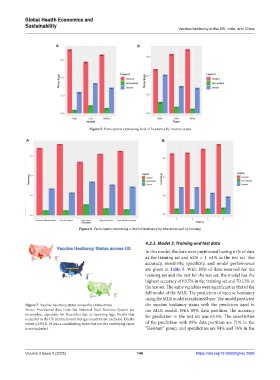
                                        Figure 5. Participants expressing level of hesitancy by income status
            A                                                         B


                                   Figure 6. Participants expressing a level of hesitancy by education and by hearing


                                                               4.2.3. Model 3: Training and test data
                                                               In this model, the data were partitioned having n1% of data
                                                               as the training set and n2% = 1−n1% as the test set. The
                                                               accuracy, sensitivity, specificity, and model performance
                                                               are given in Table 5. With 85% of data reserved for the
                                                               training set and the rest for the test set, the model has the
                                                               highest accuracy of 63.5% in the training set and 70.12% in
                                                               the test set. The same variables were significant as that of the
                                                               full model of the MLR. The prediction of vaccine hesitancy
                                                               using the MLR model is explained here. The model predicted
            Figure 7. Vaccine hesitancy status across the Unites States  the vaccine hesitancy status with the predictors used in
            Notes: Provisional data from  the National  Vital Statistics System are   the  MLR model.  With 85%  data partition, the  accuracy
            incomplete, especially for December due to reporting lags. Deaths that   for prediction in the test set was 63.5%. The sensitivities
            occurred in the US territories and foreign countries are excluded. Deaths
            where COVID-19 was a contributing factor but not the underlying cause   of the prediction with 85% data partition are 71% in the
            is not included.                                   “Hesitant” group, and specificities are 94% and 76% in the


            Volume 3 Issue 2 (2025)                        146                       https://doi.org/10.36922/ghes.2958

