


Page 186 - GHES-3-3
P. 186
Global Health Economics and
            Sustainability
                                                                                Transport and health of pregnant women


            4.5. Factors of transport exclusion                5. Discussion

            Factors such as lack of money, transport cost, availability   The study was conducted to examine various factors
            of suitable means of transport, discrimination (by drivers   contributing to transport social exclusion among pregnant
            and other commuters), accessibility to means of transport,   women in Ibadan Northeast, Ibadan North, and Ibadan
            fear-based exclusion (linked with bad road and safety   Northwest LGAs in Oyo State, South West, Nigeria.
            of  transport  means),  environment,  physical  disability,
            affordability, unemployment, and physical appearance   The results revealed that the majority of the travel
            were included in the questionnaire. The result shows   needs of the respondents fall within healthcare visits and
            that lack of money constitutes a major factor of exclusion   religious visits. This observation may be due to the need
            among 95.0% of the respondents. This is followed by   to attend medical services such as antenatal care and
            environment (86.3%),  the  physical appearance of  the   postnatal care for safe delivery among pregnant women
            respondents (84.0%), and fear (79.0%). Other factors   and to reduce infant mortality (Brown et al., 2008; Kohler,
            include discrimination (73.69%) and transport cost   2019; Nimi et al., 2016). Safe delivery facilitated by ease of
            (72.0%).  However,  accessibility to  means  of transport   access to medical care has been found to correlate with the
            constitutes a factor of exclusion for about 51.0% of all the   emotional, social, and psychological well-being of humans
            respondents,  while  physical  challenge  constitutes  about   (Banister & Bowling, 2004; Bergstad et al., 2011). In terms
            68.6% of the respondents (Table 8).                of mobility choices, motorcycles emerged as the preferred
                                                               choice by a greater percentage of the respondents. This
                                                               preference highlights the widespread use of motorcycles
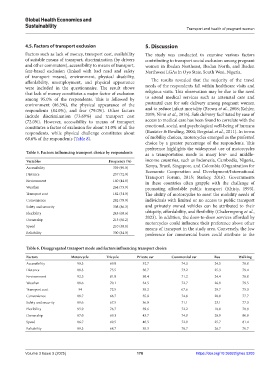
            Table 5. Factors influencing transport choice by respondents  as a transportation mode in many low-  and middle-
            Variables                          Frequency (%)   income countries, such as Indonesia, Cambodia, Nigeria,
            Accessibility                        339 (95.0)    Kenya, Brazil, Singapore, and Colombia (Organization for
            Distance                             257 (72.0)    Economic  Cooperation  and  Development/International
                                                               Transport Forum, 2015; Starkey, 2016). Governments
            Environment                          160 (44.8)    in these countries often grapple with the challenge of
            Weather                              264 (73.9)    promoting affordable public transport (Khisty, 1993).
            Transport cost                       182 (51.0)    The ability of motorcycles to meet the mobility needs of
            Convenience                          282 (79.0)    individuals with limited or no access to public transport
            Safety and security                  308 (86.3)    and privately owned vehicles can be attributed to their
            Flexibility                          245 (68.6)    ubiquity, affordability, and flexibility (Chalermpong et al.,
            Ownership                            215 (60.2)    2023). In addition, the door-to-door services afforded by
                                                               motorcycles could influence their preference above other
            Speed                                210 (58.8)    means of transport in the study area. Conversely, the low
            Reliability                          300 (84.0)    preference for commercial buses could attribute to the


            Table 6. Disaggregated transport mode and factors influencing transport choice

            Factors            Motorcycle     Tricycle     Private car    Commercial car    Bus       Walking
            Accessibility         90.3          69.9          32.7            74.3          24.5        78.8
            Distance              88.3          75.5          30.7            73.2          25.3        79.4
            Environment           92.5          81.9          39.4            71.2          24.4        78.8
            Weather               88.6          70.1          34.5            72.7          26.9        79.5
            Transport cost        94            72.5          35.2            67.6          29.7        75.3
            Convenience           88.7          66.7          35.8            74.8          28.0        77.7
            Safety and security   89.6          67.5          36.0            71.1          23.1        77.3
            Flexibility           95.9          76.7          39.6            72.2          18.0        78.8
            Ownership             87.0          69.3          43.7            74.9          20.9        80.9
            Speed                 86.7          69.5          40.5            72.9          25.7        81.4
            Reliability           89.3          68.7          35.3            70.7          26.7        76.7


            Volume 3 Issue 3 (2025)                        178                       https://doi.org/10.36922/ghes.5203

