


Page 188 - GHES-3-3
P. 188
Global Health Economics and
            Sustainability
                                                                                Transport and health of pregnant women


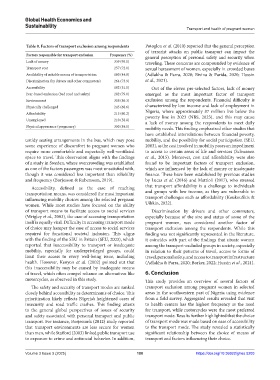
            Table 8. Factors of transport exclusion among respondents  Potoglou et al. (2010) reported that the general perception
                                                               of  terrorist  attacks  on  public  transport  can  impact the
            Factors responsible for transport exclusion  Frequency (%)  general perception of personal safety and security when
            Lack of money                         339 (95.0)   traveling. These concerns are compounded by evidence of
            Transport cost                        257 (72.0)   sexual harassment of women, especially in crowded buses
            Availability of suitable means of transportation  160 (44.8)  (Adlakha & Parra, 2020; Bivina & Parida, 2020; Hussin
            Discrimination (by drivers and other commuters)  264 (73.9)  et al., 2021).
            Accessibility                         182 (51.0)     Out of the eleven pre-selected factors, lack of money
            Fear-based exclusion (bad road and safety)  282 (79.0)  emerged as the most important factor of transport
            Environment                           308 (86.3)   exclusion among the respondents. Financial difficulty is
            Physically challenged                 245 (68.6)   characterized by low income and lack of employment in
            Affordability                         215 (60.2)   Nigeria, where approximately 87 million live below the
                                                               poverty line in 2023 (NBS, 2023), and this may cause
            Unemployed                            210 (58.8)   a lack of money among the respondents to meet daily
            Physical appearance (pregnancy)       300 (84.0)   mobility needs. This finding emphasized other studies that
                                                               have established interrelations between financial poverty,
            untidy seating arrangements in the bus, which may pose   mobility, and the possibility for social participation (SEU,
            some experience of discomfort to pregnant women who   2003), as the cost involved in mobility poses an impediment
            require more comfortable and expectedly well-ventilated   to access to certain areas of life and services (Schwanen
            space to travel. This observation aligns with the findings   et al., 2015). Moreover, cost and affordability were also
            of a study in Sweden, where overcrowding was established   found to be important factors of transport exclusion,
            as one of the factors passengers was most unsatisfied with,   which are influenced by the lack of money or inadequate
            though it was considered less important than reliability   finance. These have been established by previous studies
            and frequency (Borjesson & Rubensson, 2019).       by Lucas et al. (2016) and Mattioli (2017), who stressed
              Accessibility, defined as the ease of reaching   that transport affordability is a challenge to individuals
            transportation means, was considered the most important   and groups with low income, as they are vulnerable to
            influencing mobility choices among the selected pregnant   transport challenges such as affordability (Koukoufikis &
            women. While most studies have focused on the ability   Uihkin, 2022).
            of transport means to facilitate access to social services   Discrimination by drivers and other commuters,
            (Wrigley et al., 2003), the ease of accessing transportation   especially because of the size and status of some of the
            itself is equally vital. Difficulty in accessing transport mode   pregnant women, was considered another factor of
            of choice may hamper the ease of access to social services   transport exclusion among the respondents. While this
            required for functional  societal inclusion.  This aligns   finding was not significantly represented in the literature,
            with the finding of the SEU in Britain (SEU, 2003), which   it coincides with part of the findings that situate women
            reported that inaccessibility to transport or inadequate   among the transport-excluded groups in society, especially
            mobility, especially for underprivileged groups, could   in relation to their patterns of travel, access to forms of
            limit their access to every well-being issue, including   travel, personal safety, and access to transport infrastructure
            health. However, Kenyon et al. (2002) pointed out that   (Adlakha & Parra, 2020; Borker, 2022; Hussin et al., 2021).
            this inaccessibility may be caused by inadequate means
            of travel, which often compel reliance on alternatives like   6. Conclusion
            motorcycles, as observed in this study.            This study provides an overview of several factors of

              The safety and security of transport modes are ranked   transport exclusion among pregnant women in selected
            closely behind accessibility as determinants of choice. This   areas in the southwestern part of Nigeria using evidence
            prioritization likely reflects Nigeria’s heightened cases  of   from a field survey. Aggregated results revealed that visit
            insecurity and road traffic crashes. This finding attests   to health centers has the highest frequency as the need
            to  the  general  global  perspectives  of  issues  of  security   for transport, while motorcycles were the most preferred
            and safety associated with personal transport and public   transport mode. Results further highlighted that the choice
            transport. For instance, Borjesson’s (2012) study reported   of transport mode was made based on ease of accessibility
            that  transport  environments  are  less  secure  for  women   to the transport mode. The study revealed a statistically
            than men, while Stafford (2003) linked public transport use   significant relationship between the choice of means of
            to exposure to crime and antisocial behavior. In addition,   transport and factors influencing their choice.


            Volume 3 Issue 3 (2025)                        180                       https://doi.org/10.36922/ghes.5203

