


Page 221 - GHES-3-3
P. 221
Global Health Economics and
            Sustainability
                                                                       COVID-19 vaccination decisions and mandate impact


                                                               neutral. In contrast, most respondents (135/166, 81.3%)
                                                               reported experiencing anxiety or depression due to the
                                                               mandates,  with  close  to  one-fourth  (39/166,  23.5%)
                                                               agreeing (15/166, 9%) or strongly agreeing (24/166,
                                                               14.5%) that they had experienced suicidal thoughts due
                                                               to employer vaccination requirements. In addition, close
                                                               to half (76/166, 46%) agreed (22/166, 13.3%) or strongly
                                                               agreed (54/166, 32.5%) that they had sought help from a
                                                               counselor due to situations arising from these requirements.
                                                                 Most respondents (139/166, 84%) agreed (26/166, 16%)
            Figure 1. COVID-19 vaccination status
                                                               or strongly agreed (113/166, 68.1%) that their personal
                                                               relationships had suffered due to situations arising from
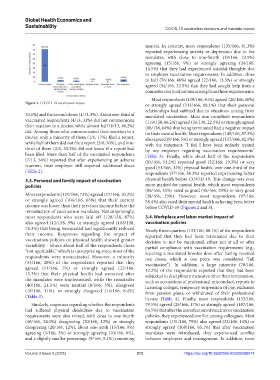
            23.1%) and the second doses (1/13, 8%). About one-third of   mandated vaccination. Most non-compliant respondents
            vaccinated respondents (4/13, 31%) did not communicate   (119/138, 86.2%) agreed (31/138, 22.5%) or strongly agreed
            their reaction to a doctor, while almost half (6/13, 46.2%)   (88/138, 64%) that being terminated had a negative impact
            did. Among those who communicated their reaction to a   on their mental health. Most respondents (145/166, 87.3%)
            doctor, only a minority of them (1/6, 17%) filed a report,   also agreed (8/166, 5%) or strongly agreed (137/166, 82.5%)
            while half of them did not file a report (3/6, 50%), and one-  with the statement, “I  feel I have been unfairly treated
            third of them (2/6, 33.3%) did not know if a report had   by  my  employer  regarding  vaccination  requirements”
            been filed. More than half of the vaccinated respondents   (Table 3). Finally, while about half of the respondents
            (7/13, 54%) reported that after experiencing an adverse   (85/166, 51.2%) reported good (32/166, 19.3%) or very
            reaction, their  employer  still  required  additional  doses   good (53/166, 32%) physical health, over one-third of the
            (Table 2).                                         respondents (57/166, 34.3%) reported experiencing better
            3.3. Personal and family impact of vaccination     physical health before COVID-19. This change was even
            policies                                           more marked for mental health, which most respondents
                                                               (86/166, 52%) rated as good (48/166, 29%) or very good
            Most respondents (121/166, 73%) agreed (17/166, 10.2%)   (38/166, 23%). However, most respondents (97/166,
            or strongly agreed (104/166, 63%) that their current   58.4%) also rated their mental health as having been better
            income was lower than their previous income before the   before COVID-19 (Figures 2 and 3).
            introduction of vaccination mandates. Not surprisingly,
            most respondents who were laid  off (120/138, 87%)   3.4. Workplace and labor market impact of
            also agreed (12/138, 9%) or strongly agreed (108/138,   vaccination policies
            78.3%) that being terminated had significantly reduced   Nearly three-quarters (133/166, 80.1%) of the respondents
            their income. Responses regarding the impact of    reported that they had been terminated due to their
            vaccination policies on physical health showed greater   decision to not be vaccinated, either not at all or after
            variability - where about half of the respondents chose   partial compliance with vaccination requirements (e.g.,
            “not applicable,” which is unsurprising since most of the   rejecting  a  mandated  booster  dose  after  having  received
            respondents were unvaccinated. However, a minority   two  doses,  which  at  one  point  was  considered  “full
            (33/166, 20%) of the respondents reported that they   vaccination”). In addition, a large minority (70/166,
            agreed (11/166, 7%) or strongly agreed (22/166,    42.2%) of the respondents reported that they had been
            13.3%) that their  physical health had worsened after   subjected to disciplinary measures other than termination,
            the mandates were implemented, while the remainder   such as accusations of professional misconduct, reports to
            (40/166, 24.1%) were neutral (8/166, 5%), disagreed   licensing colleges, temporary suspension of pay, exclusion
            (18/166, 11%), or strongly disagreed (14/166, 8.4%)   from pension plans, or withdrawal of their professional
            (Table 3).                                         license (Table 4). Finally, most respondents (132/166,
              Similarly, responses regarding whether the respondents   79.5%) agreed (25/166, 17%) or strongly agreed (107/166,
            had suffered physical disabilities due to vaccination   64.5%) that after the introduction of vaccines or vaccination
            requirements were also mixed, with close to one-fourth   policies, they experienced conflict among colleagues. Most
            (40/166, 24.1%) disagreeing (20/166, 12%) or strongly   respondents (131/166, 79%) also agreed (23/166, 14%) or
            disagreeing (20/166, 12%), about one-tenth (15/166, 9%)   strongly  agreed  (108/166,  65.1%)  that after  vaccination
            agreeing (5/166, 3%) or strongly agreeing (10/166, 6%),   mandates were introduced, they experienced conflict
            and a slightly smaller percentage (9/166, 5.4%) remaining   between employees and management. In addition, most


            Volume 3 Issue 3 (2025)                        213                 https://doi.org/10.36922/GHES025080014

