


Page 113 - GPD-1-2
P. 113
Gene & Protein in Disease                                 Exosomes connect periodontitis and systemic diseases


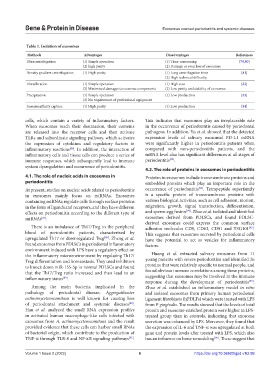
            Table 1. Isolation of exosomes
             Methods                 Advantages                         Disadvantages                References
            Ultracentrifugation     (1) Simple operation               (1) Time-consuming              [79,80]
                                    (2) high purity                    (2) Damage or even loss of exosomes
            Density gradient centrifugation  (1) High purity           (1) Long centrifugation time     [81]
                                                                       (2) High technical difficulty
            Ultrafiltration         (1) Simple operation               (1) High cost                    [82]
                                    (2) Minimized damages to exosome components  (2) Low purity and stability of exosomes
            Precipitation           (1) Simple operation               (1) Low production               [83]
                                    (2) No requirement of professional equipment
            Immunoaffinity capture  (1) High purity                    (1) Low production               [84]

            cells, which contain a variety of inflammatory factors.   This indicates that exosomes play an irreplaceable role
            When exosomes reach their destination, their contents   in the occurrence of periodontitis caused by periodontal
            are released into the receptor cells and then activate   pathogens. In addition, Yu et al. showed that the detected
            TLRs and subordinate signaling pathway, which activates   expression levels of salivary exosomal PD-L1 mRNA
            the expression of cytokines and regulatory factors  in   were  significantly  higher  in periodontitis patients when
            inflammatory reactions . In addition, the interaction of   compared with non-periodontitis patients, and the
                               [86]
            inflammatory cells and tissue cells can produce a series of   mRNA level also has significant differences at all stages of
                                                                         [92]
            immune responses, which subsequently lead to immune   periodontitis .
            system dysregulation and occurrence of periodontitis.
                                                               4.2. The role of proteins in exosomes in periodontitis
            4.1. The role of nucleic acids in exosomes in      Proteins in exosomes include transmembrane proteins and
            periodontitis                                      embedded proteins which play an important role in the
                                                                                      [93]
            At present, studies on nucleic acids related to periodontitis   occurrence of periodontitis . Tetrapeptide superfamily
            in  exosomes  mainly  focus  on  miRNAs.  Exosomes   is a specific protein of transmembrane proteins with
            containing miRNAs regulate cells through surface proteins   various biological activities, such as cell adhesion, motion,
            in the form of ligands and receptors, and they have different   migration, growth, signal transduction, differentiation,
                                                                                [94]
            effects on periodontitis according to the different type of   and sperm-egg fusion . Zhao et al. isolated and identified
            miRNAs .                                           exosomes derived from PDLSCs, and found PDLSC-
                   [87]
                                                               derived exosomes could express the common surface
              There is an imbalance of Th17/Treg in the peripheral   adhesion molecules CD9, CD63, CD81 and TSG101 .
                                                                                                           [95]
            blood of periodontitis patients, characterized by   This suggests that exosomes secreted by periodontal cells
            upregulated Th17 or downregulated Treg . Zheng et al.   have the potential to act as vesicles for inflammatory
                                             [88]
            found exosomes from PDLSCs in periodontal inflammatory   factors.
            environment induced with LPS have a regulatory effect on
            the inflammatory microenvironment by regulating Th17/  Huang  et al. extracted salivary exosomes from 11
            Treg differentiation and homeostasis. They used inhibitors   young patients with severe periodontitis and identified 26
            to knock down miR-155-5p in normal PDLSCs and found   proteins that were relatively specific to normal people, and
            that the Th17/Treg ratio increased and then lead to an   found obvious immune correlations among these proteins,
                            [89]
            inflammatory status .                              suggesting that exosomes may be involved in the immune
                                                               response during the development of periodontitis .
                                                                                                           [93]
              Among the main bacteria implicated in the        Zhao  et al.  established  an  inflammatory  model  in vitro
            pathology of periodontal disease,  Aggregatibacter   and isolated exosomes from primary human periodontal
            actinomycetemcomitans is well known for causing loss   ligament fibroblasts (hPDLFs) which were treated with LPS
            of periodontal attachment and systemic diseases .   from P. gingivalis. The results showed that the levels of total
                                                        [90]
            Han  et al.  analyzed  the  small  RNA  expression  profiles   protein and exosome-enriched protein were higher in LPS-
            in activated human macrophage-like cells infected with   treated group than in controls, indicating that exosome
            exosomes from A. actinomycetemcomitans and the result   secretion was enhanced by LPS. Moreover, they found that
            provided evidence that these cells can harbor small RNAs   the expression of IL-6 and TNF-α was upregulated at both
            of bacterial origin, which contribute to the production of   gene and protein levels after treated with LPS, which also
            TNF-α through TLR-8 and NF-κB signaling pathways .   has an influence on bone remodeling . These suggest that
                                                        [91]
                                                                                            [96]
            Volume 1 Issue 2 (2022)                         6                       https://doi.org/10.36922/gpd.v1i2.99

