


Page 106 - GPD-3-3
P. 106
Gene & Protein in Disease                                     Exploring serum inflammatory biomarkers in GBM


            compared to 20126 – 19, which exhibited little variability   pre-CRT. However, these interactions were not maintained
            across patients. The 3034 – 1 isoform was significantly   post-CRT, with only one significant inverse association with
            altered with CRT (Figure 2), while the 20126 – 19 isoform   nuclear factor kappa B (NF-κB) observed post-treatment.
            showed no significant alteration (Figure S3).      Although IL-6 alteration with CRT was not statistically
                                                               significant,  and  IL-13  met  both  the  fold  change  and
            3.2. Interaction between serum inflammatory        P-value cutoffs (Figure 2), IL-6 exhibited more significant
            biomarkers at baseline and post-CRT alterations    associations with other biomarkers (VCAM-1, TNF-α,
            We compared serum measurements from this study to   SAA, HLA-G, I kappa B kinase kappa, Prostaglandin E
            published data, which typically reports measurements   synthase 2 [PGES2], and PD-1), both pre-CRT and post-
            taken before the administration of SOC treatment, such   CRT than IL-13 (Figure  3B). The interactions involving
            as in tumor tissue samples. This analysis examined pre-  IL-13 and other markers showed unique trends compared
            CRT levels and interactions between markers at baseline,   to those of IL-6 and other markers, particularly with
            as well as their alterations after SOC CRT, to explore   NF-κB (Figure 3). Notable additional interactions include
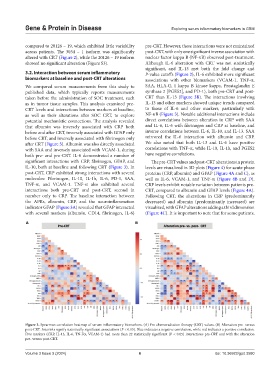
            potential mechanistic connections. The analysis revealed   direct  correlations  between  alteration  in  CRP  with  SAA
            that albumin was inversely associated with CRP both   and IL-6, IL-6 with fibrinogen and CRP at baseline, and
            before and after CRT, inversely associated with GFAP only   inverse correlations between IL-6, IL-10, and IL-13. SAA
            before CRT, and inversely associated with fibrinogen only   mirrored the IL-6 interaction with albumin and CRP.
            after CRT (Figure 3). Albumin was also directly associated   We also noted that both IL-13 and IL-6 have positive
            with SAA and inversely associated with VCAM-1, during   correlations with TNF-α, while IL-10, IL-1b, and PGES2
            both pre- and pro-CRT. IL-6 demonstrated a number of   have negative correlations.
            significant interactions with CRP, fibrinogen, GFAP, and   The pre-CRT values and post-CRT alterations in protein
            IL-10, both at baseline and following CRT (Figure 3). In   levels are visualized in 3D plots (Figure 4) for acute phase
            post-CRT, CRP exhibited strong interactions with several   proteins (CRP, albumin) and GFAP (Figure 4A and C), as
            molecules: Fibrinogen, IL-10, IL-1b, IL-6, PD-1, SAA,   well as IL-6, VCAM-1, and TNF-α  (Figure  4B  and  D).
            TNF-α, and VCAM-1. TNF-α also exhibited several    CRP levels exhibit notable variation between patients pre-
            interactions both pre-CRT and post-CRT, second in   CRT, compared to albumin and GFAP levels (Figure 4A).
            number only to CRP. The baseline interaction between   Following CRT, the alterations in CRP (predominantly
            the  APRs,  albumin,  CRP,  and  the  neuroinflammation   decreased) and albumin (predominantly increased) are
            indicator GFAP (Figure 3A) revealed that GFAP interacted   visualized, with GFAP alterations adding a third dimension
            with several markers (albumin, CD14, fibrinogen, IL-6)   (Figure 4C). It is important to note that for some patients,
            A                                              B


            Figure 3. Spearman correlation heatmap of serum inflammatory biomarkers. (A) Pre-chemoradiation therapy (CRT) values. (B) Alteration pre- versus
            post-CRT. Asterisks signify statistically significant associations (P < 0.05). Blue indicates a negative correlation, while red indicates a positive correlation.
            Five markers (CRP, IL-13, IL-6, TN-Fα, VCAM-1) had more than 22 statistically significant (P < 0.05) interactions pre-CRT and with the alteration
            pre- versus post-CRT.


            Volume 3 Issue 3 (2024)                         6                               doi: 10.36922/gpd.3580

