


Page 107 - GPD-3-3
P. 107
Gene & Protein in Disease                                     Exploring serum inflammatory biomarkers in GBM


                        A                                  C


                        B                                  D


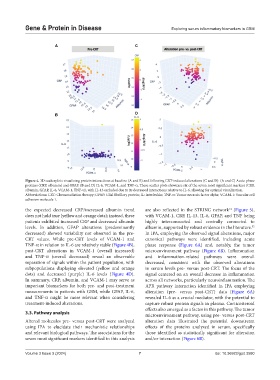
            Figure 4. 3D scatterplots visualizing protein interactions at baseline (A and B) and following CRT-induced alterations (C and D). (A and C) Acute phase
            proteins (CRP, albumin) and GFAP. (B and D) IL-6, VCAM-1, and TNF-α. These scatter plots showcase six of the seven most significant markers (CRP,
            albumin, GFAP, IL-6, VCAM-1, TNF-α), with IL-13 excluded due to its decreased interactions relative to IL-6, allowing for optimal visualization.
            Abbreviations: CRT: Chemoradiation therapy; GFAP: Glial fibrillary protein; IL: Interleukin; TNF-α: Tumor necrosis factor alpha; VCAM-1: Vascular cell
            adhesion molecule 1.

            the  expected  decreased  CRP/increased  albumin  trend   are also reflected in the STRING network  (Figure  5),
                                                                                                  14
            does not hold true (yellow and orange dots); instead, these   with VCAM-1, CRP, IL-13, IL-6, GFAP, and TNF being
            patients exhibited increased CRP and decreased albumin   highly interconnected and centrally connected to
                                                                                                            52
            levels. In addition, GFAP alterations (predominantly   albumin, supported by robust evidence in the literature.
            decreased) showed variability not observed in the pre-  In IPA, employing the observed signal alterations, major
            CRT values. While pre-CRT levels of VCAM-1 and     canonical pathways were identified, including acute
            TNF-α in relation to IL-6 are relatively stable (Figure 4B),   phase response (Figure  6A) and, notably, the tumor
            post-CRT alterations in VCAM-1 (overall increased)   microenvironment pathway (Figure  6B). Inflammation
            and TNF-α (overall decreased) reveal an observable   and inflammation-related pathways were overall
            separation of signals within the patient population, with   decreased, consistent with the observed alterations
            subpopulations displaying elevated (yellow and orange   in serum levels pre- versus post-CRT. The focus of the
            dots) and decreased (purple) IL-6 levels (Figure  4D).   signal centered on an overall decrease in inflammation
            In summary, CRP, albumin, and VCAM-1 may serve as   across all networks, particularly neuroinflammation. The
            important biomarkers for both pre-  and post-treatment   APR pathway interaction identified in IPA employing
            measurements in patients with GBM, while GFAP, IL-6,   alteration (pre-  versus post-CRT) data (Figure  6A)
            and  TNF-α  might  be  more  relevant  when  considering   revealed IL-6 as a crucial mediator, with the potential to
            treatment-induced alterations.                     capture robust protein signals in plasma. Corticosteroid
                                                               effects also emerged as a factor in this pathway. The tumor
            3.3. Pathway analysis                              microenvironment pathway, using pre- versus post-CRT
            Altered molecules pre-  versus post-CRT  were analyzed   alteration data illustrated the potential downstream
            using IPA to elucidate their mechanistic relationships   effects  of  the  proteins  analyzed  in  serum,  specifically
            and relevant biological pathways. The associations for the   those identified as statistically significant for alteration
            seven most significant markers identified in this analysis   and/or interaction (Figure 6B).


            Volume 3 Issue 3 (2024)                         7                               doi: 10.36922/gpd.3580

