


Page 103 - GPD-3-3
P. 103
Gene & Protein in Disease                                     Exploring serum inflammatory biomarkers in GBM


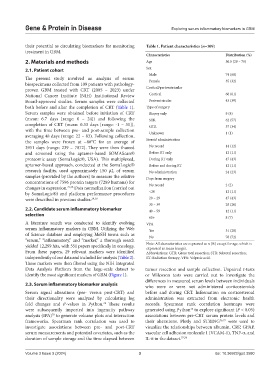
            their potential as circulating biomarkers for monitoring   Table 1. Patient characteristics (n=109)
            treatment in GBM.
                                                               Characteristics                   Distribution (%)
            2. Materials and methods                           Age                               56.5 (29 – 79)

            2.1. Patient cohort                                Sex
                                                                Male                             74 (68)
            The present study involved an analysis of serum     Female                           35 (32)
            biospecimens collected from 109 patients with pathology-
            proven GBM treated with CRT (2005 – 2023) under    Cortical/periventricular
            National Cancer Institute (NIH) Institutional Review   Cortical                      66 (61)
            Board-approved studies. Serum samples were collected   Periventricular               43 (39)
            both before and after the completion of CRT (Table 1).   Type of surgery
            Serum samples were obtained before initiation of CRT   Biopsy only                   9 (8)
            (mean: 6.7  days [range: 0 – 24]) and following the   STR                            62 (57)
            completion of CRT (mean: 0.33  days [range:  -1 – 31]),   GTR                        37 (34)
            with the time between pre-  and post-sample collection   Unknown                     1 (1)
            averaging 48 days (range: 22 – 83). Following collection,
            the samples were frozen at −80°C for an average of   Steroid administration
            3951  days (range: 239 – 7072). They were then thawed   No record                    14 (12)
            and screened using the aptamer-based SOMAScan®      Before RT only                   12 (11)
            proteomic assay (SomaLogic®, USA). This multiplexed,   During RT only                47 (43)
            aptamer-based approach, conducted at the SomaLogic®   Before and during RT           12 (11)
            research facility, used approximately 150  μL of serum   No administration           24 (23)
            samples (provided by the authors) to measure the relative   Days from surgery
            concentrations of 7596 protein targets (7289 humans) for
            changes in expression. 27,28  Data normalization (carried out   No record            2 (2)
            by SomaLogic®) and platform performance procedures   <20                             12 (11)
            were described in previous studies. 29,30           20 – 29                          47 (43)
                                                                30 – 39                          28 (26)
            2.2. Candidate serum inflammatory biomarker         40 – 59                          12 (11)
            selection
                                                                60+                              8 (7)
            A literature search was conducted to identify evolving   VPA
            serum  inflammatory  markers  in  GBM.  Utilizing  the  Web   Yes                    31 (28)
            of Science database and employing MeSH terms such as   No                            78 (72)
            “serum,” “inflammatory,” and “marker,” a thorough search
            yielded 12,299 hits, with 551 papers specifically in oncology.   Note: All characteristics are expressed as n (%) except for age, which is
                                                               expressed as mean (range).
            From these papers, 29 relevant markers were identified   Abbreviations: GTR: Gross total resection; STR: Subtotal resection;
            independently of our data and included for analysis (Table 2).   RT: Radiation therapy; VPA: Valproic acid.
            These markers were then filtered using the NIH Integrated
            Data Analysis Platform from the large-scale dataset to   tumor resection and sample collection. Unpaired t-tests
            identify the most significant markers of GBM (Figure 1).  or Wilcoxon tests were carried out to investigate the
                                                               differences in measured serum levels between individuals
            2.3. Serum inflammatory biomarker analysis         who were or were not administered corticosteroids
            Serum signal alterations (pre-  versus post-CRT) and   before and during CRT. Information on corticosteroid
            their directionality  were  analyzed  by calculating  log   administration was extracted from electronic health
            fold changes and  P-values in Python.  These results   records. Spearman rank correlation heatmaps were
                                             74
            were subsequently imported into ingenuity pathway   generated using Python  to explore significant (P < 0.05)
                                                                                  74
            analysis (IPA)  to generate volcano plots and interaction   associations between pre-CRT serum protein levels and
                       75
            frameworks.  Spearman rank correlation was used to   their alterations. Plotly and STRING 76,77  were used to
            investigate associations between pre-  and post-CRT   visualize the relationships between albumin, CRP, GFAP,
            serum measurements and potential covariates, such as the   vascular cell adhesion molecule 1 (VCAM-1), TNF-α, and
            duration of sample storage and the time elapsed between   IL-6 in the dataset. 77,78


            Volume 3 Issue 3 (2024)                         3                               doi: 10.36922/gpd.3580

