


Page 14 - GTM-1-1
P. 14
Global Translational Medicine                                       ZnO NPs induce apoptosis in MG63 cells


            3.10. Effect of ZnO NPs on DNA damage              apoptosis-related proteins in ZnO NPs-treated MG63 cells.

            The comet test demonstrated that the ZnO NPs caused   In comparison to untreated cells, the injection of ZnO
            DNA  damage  in MG63  cells. In  untreated  control cells,   NPs significantly reduced the expression levels of p-P13K,
            we observed normal, intact DNA in the electrophoresis   p-AKT, and p-mTOR, depending on the concentrations
            plot. On the contrary, the damaged increased head DNA   applied (Figure  8A and B). The activation of multiple
            was  detected  in  ZnO  NPs-exposed  cells.  The  increased   conjugation processes mediate the lipidation of LC3 onto
            DNA head DNA was directly associated with increasing   cell membranes, thereby transforming LC3-I to LC3-II.
            concentrations of ZnO NPs (Figure 6A).             The LC3-positive puncta indicative of this lapidated form
                                                               is required for autophagosome formation. The treatment
            3.11. Effect of ZnO NPs on caspase-3, -8, and -9   of ZnO NPs at the doses utilized in MG63 cells caused the
            The expression of caspase-3, -8, and -9 in MG63 cells was   conversion of LC3-I to its lapidated LC3-II form, as shown
            ascertained by standard protocols. When comparing ZnO   by Western blot results. Furthermore, ZnO NPs treatment
            NPs-administered MG63 cells to control cells, the levels of   considerably increased beclin1 expression. Nevertheless,
            caspase-3, -8, and -9 were increased in a concentration-  another autophagy marker, P62, was dramatically decreased
            dependent manner. The  graphical representation of   by MG63 treatment at doses determined (Figure 8C). The
            caspase-3, -8, and -9 is depicted graphically (Figure 6B).  relative expression of LC3, beclin-1, and P62 versus β-actin
                                                               is depicted in the graph (Figure 8D).
            3.12. Effect of ZnO NPs on p53, Bcl-2, and Bax
            protein expression                                 4. Discussion
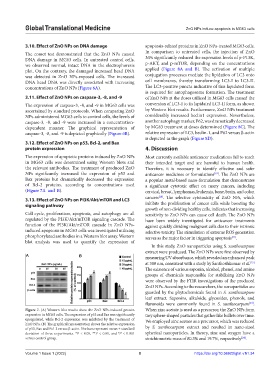
            The expression of apoptotic proteins induced by ZnO NPs   Most currently available anticancer medications fail to reach
            in MG63  cells was determined using Western blots and   their intended target and are harmful to human health.
            the relevant antibodies. The treatment of produced ZnO   Therefore, it is necessary to identify effective and safer
            NPs significantly increased the expression of p53 and   anticancer medicines or formulations . The ZnO NPs are
                                                                                            [19]
            Bax  proteins  but dramatically  decreased  the  expression   a popular metal-based nano-formulation that demonstrates
            of Bcl-2 proteins, according to concentrations used   a  significant  cytotoxic  effect  on  many  cancers,  including
            (Figure 7A  and  B).                               cervical, breast, lymphomas, leukemia, bone, brain, and colon
                                                                     [20]
            3.13. Effect of ZnO NPs on PI3K/Akt/mTOR and LC3   cancers . The selective cytotoxicity of ZnO NPs, which
            signaling pathway                                  inhibits the proliferation of cancer cells while boosting the
                                                               growth of non-dividing healthy cells, indicates that increasing
            Cell cycle, proliferation, apoptosis, and autophagy are all   sensitivity to ZnO NPs can cause cell death. The ZnO NPs
            regulated by the PI3K/Akt/mTOR signaling cascade. The   have been  widely investigated for anticancer  treatments
            function  of  the  PI3K/Akt/mTOR  cascade  in  ZnO  NPs-  against quickly dividing malignant cells due to their intrinsic
            induced apoptosis in MG63 cells was investigated utilizing   selective toxicity. The stimulation of extreme ROS generation
            phosphorylated antibodies in a Western blot assay. Western   serves as the major factor in triggering apoptosis .
                                                                                                    [21]
            blot analysis was used to quantify the expression of
                                                                 In this study, ZnO nanoparticles using S. xanthocarpum
                                                               extract were produced. The ZnO NPs were first observed by
            A                      B                           measuring UV absorbance, which revealed an enhanced peak
                                                               at 380 nm, consistent with a study by Santhoshkumar et al.
                                                                                                           [22]
                                                               The existence of various saponin, alcohol, phenol, and amine
                                                               groups of chemicals responsible for stabilizing ZnO NPs
                                                               were observed by the FTIR investigations of the produced
                                                               ZnO NPs. According to the researchers, the nanoparticles are
                                                               guarded by the phytochemicals found in S. xanthocarpum
                                                               leaf extract. Saponins, alkaloids, glycosides, phenols, and
                                                               flavonoids were commonly found in  S. xanthocarpum .
                                                                                                           [23]
            Figure 7. (A) Western blot results show the ZnO NPs-induced protein   When zinc acetate is used as a precursor, the ZnO NPs form
            expression in MG63 cells. The expression of p53 and Bax was significantly   tiny sphere-shaped particles that gather like bullets over time.
            upregulated, while Bcl-2 expression was inhibited by the treatment of   We employed zinc acetate as a precursor, which was reduced
            ZnO NPs. (B) The graphical representation shows the relative expression
            of p53, Bax and Bcl-2 versus β-actin. The bars represent mean ± standard   by  S. xanthocarpum extract and resulted in nano-sized
            deviation of three experiments. *P  < 0.05, **P < 0.01, and  P < 0.001   spherical nanoparticles. In theory, zinc and oxygen have a
                                                   #
            versus control group.                              stoichiometric mass of 80.3% and 19.7%, respectively .
                                                                                                        [24]
            Volume 1 Issue 1 (2022)                         8                       https://doi.org/10.36922/gtm.v1i1.34

