


Page 11 - GTM-1-1
P. 11
Global Translational Medicine                                       ZnO NPs induce apoptosis in MG63 cells


            A                                                  ions.  The  unique  signals  were  acquired  from  the
                                                               substance-distinct  vibrations  of  the  ZnO  NPs-coupled
                                                               biomolecules (Figure  3). The band at 3424-3452 cm
                                                                                                            −1
                                                               assisted in determining the functional groups associated
                                                               with nanoparticles. The strong, deep absorption peak at
                                                                      −1
                                                               3424 cm  represents the stretching of alcohol groups O-H.
                                                               The  C=C  stretching  vibrations  of  primary  amines  were
                                                               responsible for the absorption band at about 1632 cm .
                                                                                                            −1
                                                               The O-H vibrations of aromatic groups were responsible
                                                               for  the vibration bounds observed  at 1382  cm . The
                                                                                                        −1
                                                                      −1
            B                                                  1110 cm  band shows the existence of C-O stretching
                                                               in alcohol, carboxylic acids, an ester, and other group
                                                               compounds. The band verifies the stretching vibration of
                                                               ZnO NPs at 452 cm .
                                                                               −1
                                                               3.5. Cytotoxic effect of ZnO NPs on MG63 cells
                                                               The ZnO NPs-induced cytotoxic effect on MG63 and
                                                               normal Vero cells were determined by MTT assay. The
                                                               administration of ZnO NPs has attenuated the  cell
                                                               proliferation in MG63 cells in a dose-dependent manner.
                                                               The concentration of ZnO NPs required for 50% inhibition
                                                               of MG63 cells was recorded as 28.12 ± 0.42 µg/mL. As a
                                                               result, we selected dosages of 15, 30, and 45  µg/mL for
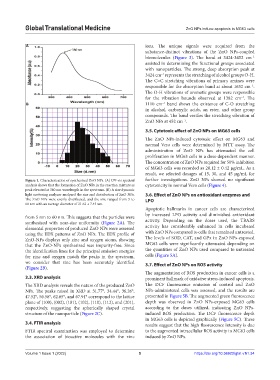
            Figure 1. Characterization of synthesized ZnO NPs. (A) UV-vis spectral   further investigations. ZnO NPs showed no significant
            analysis shows that the formation of ZnO NPs in the reaction mixture as   cytotoxicity in normal Vero cells (Figure 4).
            peak elevated at 380 nm wavelength in the spectrum. (B) A size dynamic
            light scattering analyzer analyzed the size and distribution of ZnO NPs.   3.6. Effect of ZnO NPs on antioxidant enzymes and
            The ZnO NPs were evenly distributed, and the size ranged from 5 to   LPO
            60 nm with an average diameter of 21.62 ± 7.45 nm.
                                                               Apoptotic hallmarks in cancer cells are characterized
                                                               by increased LPO activity and diminished antioxidant
            from 5 nm to 60 nm. This suggests that the particles were
            synthesized with near-size uniformity (Figure  2A). The   activity.  Depending  on  the  doses  used,  the  TBARS
            elemental properties of produced ZnO NPs were assessed   activity  has considerably enhanced  in cells  incubated
            using the EDX patterns of ZnO NPs. The EDX profile of   with ZnO NPs compared to cells that remained untreated.
            ZnO-NPs displays only zinc and oxygen atoms, showing   The levels of SOD, CAT, and GPx in ZnO NPs-exposed
            that the ZnO-NPs synthesized was impurity-free. Since   MG63  cells were significantly attenuated depending on
            the identification lines for the principal emission energies   the quantities of ZnO NPs used compared to untreated
            for zinc and oxygen match the peaks in the spectrum,   cells (Figure 5A).
            we consider that zinc has been accurately identified   3.7. Effect of ZnO NPs on ROS activity
            (Figure 2B).
                                                               The augmentation of ROS production in cancer cells is a
            3.3. XRD analysis                                  prominent hallmark of oxidative stress-induced apoptosis.
            The XRD analysis reveals the nature of the produced ZnO   The DCF fluorescence emission of control  and ZnO
            NPs.  The  peaks  raised  in  XRD  at  31.77°,  34.44°,  36.26°,   NPs-administered cells was assessed, and the results are
            47.52°, 56.58°, 62.85°, and 67.91° correspond to the lattice   presented in Figure 5B. The augmented green fluorescence
            plane of (100), (002), (101), (102), (110), (112), and (201),   depth was observed in ZnO NPs-exposed MG63  cells
            respectively, suggesting the spherically shaped crystal   according to the doses utilized, indicating ZnO NPs-
            structure of the nanoparticle (Figure 2C).         induced  ROS  production. The  DCF  fluorescence  depth
                                                               in MG63 cells is depicted graphically (Figure 5C). These
            3.4. FTIR analysis                                 results suggest that the high fluorescence intensity is due
            FTIR spectral examination was employed to determine   to the augmented intracellular ROS activity in MG63 cells
            the association of bioactive molecules with the zinc   induced by ZnO NPs.


            Volume 1 Issue 1 (2022)                         5                       https://doi.org/10.36922/gtm.v1i1.34

