


Page 15 - GTM-1-1
P. 15
Global Translational Medicine                                       ZnO NPs induce apoptosis in MG63 cells


                        A                                      B


                        C                                      D


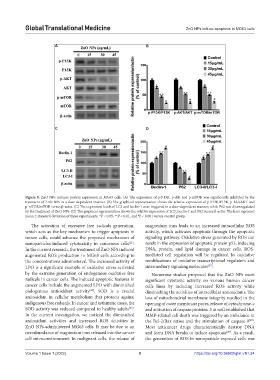
            Figure 8. ZnO NPs induces protein expression in MG63 cells. (A) The expression of p-P13K, p-Akt and p-mTOR was significantly inhibited by the
            treatment of ZnO NPs in a dose-dependent manner. (B) The graphical representation shows the relative expression of p-P13K/P13K, p-Akt/AKT and
            p-mTOR/mTOR versus β-actin. (C) The expression levels of LC3 and beclin-1 were triggered in a dose-dependent manner, while P62 was downregulated
            by the treatment of ZnO NPs. (D) The graphical representation shows the relative expression of LC3, beclin-1 and P62 versus β-actin. The bars represent
                                                            #
            mean ± standard deviation of three experiments. *P < 0.05, **P < 0.01, and  P < 0.001 versus control group.
              The activation of excessive free radicals generation,   magnesium ions leads to an increased intracellular ROS
            which acts as the key mechanism to trigger apoptosis in   activity, which activates apoptosis through the apoptotic
            tumor cells, could advance the proposed mechanism of   signaling pathway. Oxidative stress generated by ROS can
            nanoparticles-induced cytotoxicity in cancerous cells .   result in the expression of apoptotic protein p53, inducing
                                                        [21]
            In the current research, the treatment of ZnO NPs induced   DNA, protein, and lipid damage in cancer cells. ROS-
            augmented ROS production in MG63 cells according to   mediated cell regulation will be regulated by oxidative
            the concentrations administered. The increased activity of   modifications of oxidative transcriptional regulators and
                                                                                         [27]
            LPO is a significant example of oxidative stress activated   intermediary signaling molecules .
            by the extreme generation of endogenous oxidative free   Numerous studies proposed that the ZnO NPs exert
            radicals in cancer cells. The induced apoptotic features in   significant cytotoxic activity on various human cancer
            cancer cells include the augmented LPO with diminished   cells  lines  by  inducing  increased  ROS  activity  while
            endogenous antioxidant activity . SOD is a crucial   diminishing the activities of intracellular antioxidants. The
                                       [25]
            antioxidant in cellular metabolism that protects against   loss of mitochondrial membrane integrity resulted in the
            indigenous free radicals. In cancer and asthmatic cases, the   opening of outer membrane pores, release of cytochrome-c
            SOD activity was reduced compared to healthy adults .   and activation of caspase proteins. It is well established that
                                                        [26]
            In the current investigation, we noticed the diminished   MMP-related cell death was triggered by an imbalance in
            antioxidant activities and increased ROS activities in   the Bcl-2/Bax ratios and the stimulation of caspase-9 .
                                                                                                           [28]
            ZnO NPs-administered MG63 cells. It may be due to an   Most anticancer drugs characteristically destroy DNA
            overabundance of magnesium ions released into the cancer   and form DNA breaks to induce apoptosis . As a result,
                                                                                                 [29]
            cell microenvironment. In malignant cells, the release of   the generation of ROS in nanoparticle-exposed cells was

            Volume 1 Issue 1 (2022)                         9                       https://doi.org/10.36922/gtm.v1i1.34

