


Page 20 - GTM-1-1
P. 20
Global Translational Medicine                                Anticancer effect of S. xanthocarpum on KB cell line


            are most frequent oral mucosal cancer type and the rate   2.2. Preparation of S. xanthocarpum extract
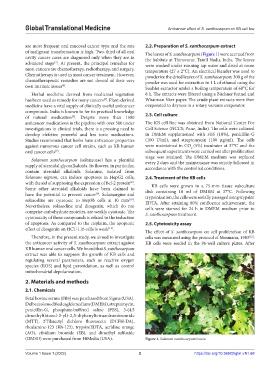
            of malignant transformation is high. Two-third of all oral   The leaves of S. xanthocarpum (Figure 1) were accrued from
            cavity cancer cases are diagnosed only when they are in   the habitats at Thiruvarur, Tamil Nadu, India. The leaves
                        [3]
            advanced stage . At present, the principal remedies for   were washed under running tap water and dried at room
            most cancers are chemotherapy, radiotherapy, and surgery.   temperature (27 ± 2°C). An electrical blender was used to
            Chemotherapy is used in most cancer treatment. However,   powderize the dried leaves of S. xanthocarpum; 300 g of the
            chemotherapeutic remedies are not devoid of their very   powder was used for extraction in 1 L of ethanol using the
                           [4]
            own intrinsic issues .                             Soxhlet extractor under a boiling temperature of 68°C for
              Herbal medicine derived from medicinal vegetation   8 h. The extracts were filtered using a Büchner funnel and
            has been used as remedy for many cancers . Plant-derived   Whatman filter paper. The crude plant extracts were then
                                             [5]
            medicine have a vital supply of clinically useful anticancer   evaporated to dryness in a rotary vacuum evaporator.
            compounds. India is known to for its practical knowledge
                                [6]
            of natural medication . Despite more than 1500     2.3. Cell culture
            anticancer medications in the pipeline with over 500 under   The KB cell line was obtained from National Center For
            investigations in clinical trials, there is a pressing need to   Cell Science (NCCS; Pune, India). The cells were cultured
            develop efefctive powerful and less toxic medications.   in DMEM supplemented with FBS (10%), penicillin-G
            Studies recommend that herbs have anticancer properties   (100 U/ml), and streptomycin (100  µg/ml). The cells
            against numerous cancer cell strains, such as KB human   were maintained in CO (5%) incubator at 37°C and the
                                                                                  2
            oral cancer cells .                                subsequent experiments were carried out after proliferation
                         [7]
                                                               stage was attained. The DMEM medium was replaced
              Solanum xanthocarpum  (solanaceae) has a plentiful
            supply of steroidal glycoalkaloids. Its flowers, in particular,   every 2 days and the maintenance was strictly followed in
                                                               accordance with the controlled conditions.
            contain  steroidal  alkaloids.  Solanine,  isolated  from
            Solanum  nigrum, can induce apoptosis in HepG2  cells,   2.4. Treatment of the KB cells
            with the aid of suppresing the expression of Bcl-2 protein .   KB cells were grown in a 75-mm tissue subculture
                                                        [8]
            Some other steroidal alkaloids have been claimed to   dish containing 10  ml of DMEM at 37°C. Following
                                          [9]
            have the potential to prevent cancer . Solamargine and   trypsinization, the cells were serially passaged using trypsin/
            solasodine are cytotoxic to Hep3b cells at 10  mm .   EDTA. After attaining 80% confluence achievement, the
                                                        [10]
            Nevertheless, solasodine and diosgenin, which do not   cells were starved for 24  h in DMEM medium prior to
            comprise carbohydrate moieties, are weakly cytotoxic. The   S. xanthocarpum treatment.
            cytotoxicity of these compounds is related to the induction
            of apoptosis. As compared to the cisplatin, the apoptotic   2.5. Cytotoxicity assay
            effect of diosgenin on HCT-116 cells is weak .
                                               [11]
                                                               The effect of  S.  xanthocarpum on cell proliferation of KB
              Therefore, in the present study, we aimed to investigate   cells was measured using the protocol of Mosmann, 1983 .
                                                                                                           [12]
            the anticancer activity of S. xanthocarpum extract against   KB cells were seeded in the 96-well culture plates. After
            KB human oral cancer cells. We found that S. xanthocarpum
            extract was able to suppress the growth of KB cells and
            regulating several parameters, such as reactive oxygen
            species (ROS) and lipid peroxidation, as well as control
            mitochondrial depolarization.

            2. Materials and methods
            2.1. Chemicals
            Fetal bovine serum (FBS) was purchased from Sigma (USA).
            Dulbecco’s modified eagle’s medium (DMEM), streptomycin,
            penicillin-G, phosphate-buffered saline (PBS), 3-(4,5
            dimethylthiozol-2-yl)-2,5-diphenyltetrazoliumbromide
            (MTT), 2’7’diacetyl dichloro fluorescein (DCFH-DA),
            rhodamine-123 (Rh-123), trypsin/EDTA, acridine orange
            (AO), ethidium bromide (EB), and dimethyl sulfoxide
            (DMSO) were purchased from HiMedia (USA).          Figure 1. Solanum xanthocarpum leaves.


            Volume 1 Issue 1 (2022)                         2                       https://doi.org/10.36922/gtm.v1i1.68

