


Page 22 - GTM-1-1
P. 22
Global Translational Medicine                                Anticancer effect of S. xanthocarpum on KB cell line


            3.2. ROS generation induced by S. xanthocarpum     A

            S. xanthocarpum induced ROS generation in KB cells.
            Excessive generation of ROS may lead to oxidative stress,
            loss of cell functions, and ultimately, apoptosis. To depict
            the role of ROS in  S. xanthocarpum-induced cell death,
            intracellular  ROS production  was detected  using  an   B
            oxidant sensitive fluorescent probe, DCFH-DA. As shown
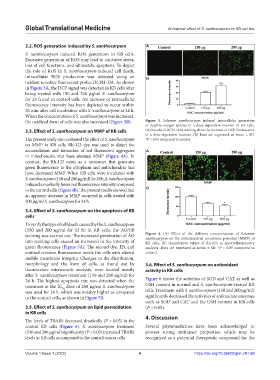
            in Figure 3A, the DCF signal was detected in KB cells after
            being treated with 150 and 200  µg/ml  S. xanthocarpum
            for 24 h and in control cells. An increase of intracellular
            fluorescence intensity has been depicted to occur within
            20 min after cell incubation with S. xanthocarpum at 24 h.
            When the concentration of S. xanthocarpum was increased,
            the oxidized form of cells was also increased (Figure 3B).  Figure  3.  Solanum xanthocarpum induced intracellular generation
                                                               of reactive oxygen species in a dose-dependent manner in KB cells.
            3.3. Effect of S. xanthocarpum on MMP of KB cells  (A) Results of DCFH‐DA staining show the increase of DCF fluorescence
                                                               in a  dose‐dependent manner. (B)  Data are expressed as  mean ± SD.
            The present study also evaluated the effect of S. xanthocarpum   *P < 0.05 compared to control.
            on MMP in KB cells. Rh-123 dye was used to detect the
            accumulation and formation of red fluorescent aggregates   A
            in mitochondria that have elevated MMP (Figure  4A). In
            contrast, the Rh-123 exists as a monomer that generates
            green fluorescence in the cytoplasm and mitochondria that
            have decreased MMP. When KB cells were incubated with
            S. xanthocarpum (150 and 200 µg/ml) for 24 h, S. xanthocarpum
            induced a markedly lower red fluorescence intensity compared
            to the control cells (Figure 4B). The present results showed that   B
            an apparent decrease in MMP occurred in cells treated with
            200 µg/ml S. xanthocarpum for 24 h.
            3.4. Effect of S. xanthocarpum on the apoptosis of KB
            cells
            To verify the type of cell death caused by the S. xanthocarpum
            (150 and 200  µg/ml for 12  h) in KB cells, the AO/EB
            staining was carried out. The increased penetration of AO   Figure  4.  (A) Effect of the different concentrations of  Solanum
                                                               xanthocarpum on the mitochondrial membrane potential (MMP) of
            into residing cells caused an increased in the intensity of   KB cells. (B) Quantitative values of Rh‐123 in spectrofluorometry
            green fluorescence (Figure 5A). The second dye, EB, and   analyses.  Data  are  expressed  as  mean  ±  SD.  *P  <  0.05  compared  to
            emitted crimson fluorescence inside the cells with altered   control.
            mobile membrane integrity. Changes in the distribution,
            morphology and the form of cells, as found out by   3.6. Effect of S. xanthocarpum on antioxidant
            fluorescence  microscopic  analysis,  were  located  mostly   activity in KB cells
            after S. xanthocarpum treatment (150 and 200 µg/ml) for
            24  h. The highest apoptosis rate was detected when the   Figure 6 shows the activities of SOD and CAT as well as
            treatment at the IC  dose of 200 µg/ml S. xanthocarpum   GSH content in normal and S. xanthocarpum-treated KB
                           50
            was used for 24 h, which was notably higher as compared   cells. Treatment with S. xanthocarpum (150 and 200 µg/ml)
            to the control cells, as shown in Figure 5B.       significantly decreased the activities of antioxidant enzymes
                                                               such as SOD and CAT and the GSH content in KB cells
            3.5. Effect of S. xanthocarpum on lipid peroxidation   (P < 0.05).
            in KB cells
            The levels of TBARS decreased drastically (P < 0.05) in the   4. Discussion
            control KB cells (Figure  6).  S. xanthocarpum treatment   Several phytomedicines have been acknowledged to
            (150 and 200 µg/ml) significantly (P < 0.05) increased TBARS   possess strong antitumor properties, which may be
            levels in KB cells as compared to the control cancer cells.  recognized as a potential therapeutic compound for the


            Volume 1 Issue 1 (2022)                         4                       https://doi.org/10.36922/gtm.v1i1.68

