


Page 21 - GTM-1-1
P. 21
Global Translational Medicine                                Anticancer effect of S. xanthocarpum on KB cell line


            administering  S. xanthocarpum extract in different doses   dismutase  (SOD)  and catalase  (CAT) activities  were
            (50 – 350 µg/ml), the cells were then incubated overnight in   measured using the methods by Beyer and Fridovich
                                                                                                           [14]
            CO  incubator. Afterward, MTT dye was added to each well   and Aebi , respectively. The measurement of glutathione
                                                                      [15]
               2
            in a series of doses (50, 100, 150, 200, 300, and 350 µg/ml) and   (GSH) content was carried out using the method by
            the cells were incubated for an additional 4 h at 37°C. After   Griffith  and 5,5’dithiobis-2-  nitrobenzoic acid, DTNB
                                                                     [16]
            the brief incubation, the DMEM medium in each well was   (Sigma chemical Co., USA). Measurement of MAD
            discarded and DMSO was added to dissolve the formazan.   formation was accomplished through its response with
            The absorbance was measured at 490  nm in a microplate   thiobarbituric acid reactive substances (TBARS) using the
            reader (Bio-Rad). The absorbance data were expressed in   method by Ohkawa et al. (1979) .
                                                                                        [17]
            percentage with respect to the control. The half maximal
            inhibitory concentration (IC ) values were calculated and   2.10. Statistical analysis
                                  50
            the optimum doses were analyzed at different time period.  The data are expressed as mean ± standard deviation (SD)
                                                               and statistical comparisons were carried out by one-way
            2.6. Measurement of ROS in KB cells                analysis of variance and Duncan’s multiple range test using
            DCF oxidized by radicals were visualized at excitation   SPSS version 17.0. The results were considered statistically
            wavelength of 535 nm and emission wavelength of 485 nm.   significant if P < 0.05.
            DCF is not oxidized by hydrogen peroxide or superoxide
            anion radical. Overnight grown cells were treated in 24-well   3. Results
            plates for 24 h. After exposure, KB cells were subjected to   3.1. Effect of S. xanthocarpum on the proliferation of
            centrifugation and loaded with DCFH-DA (20  µM/ml)   KB cells
            in growth medium, and then, the cells were incubated for
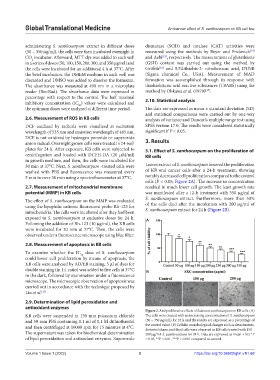
            30 min at 37°C. Next, S. xanthocarpum -treated cells were   Leaves extract of S. xanthocarpum lowered the proliferation
            washed with PBS and fluorescence was measured every   of KB oral cancer cells after a 24-h treatment, showing
            5 min in over 30 min using a spectrofluorometer at 37°C.  notably decreased cell proliferation compared to the control
                                                               cells (P < 0.05; Figure 2A). The increase in concentration
            2.7. Measurement of mitochondrial membrane         resulted in much lower cell growth. The least growth rate
            potential (MMP) in KB cells                        was manifested after a 12-h treatment with 350 µg/ml of
            The effect of S. xanthocarpum on the MMP was evaluated   S. xanthocarpum extract. Furthermore, more than 50%
            using the lipophilic cationic fluorescent probe Rh-123 for   of the cells died after the incubation with 200  µg/ml of
            mitochondria. The cells were incubated after they had been   S. xanthocarpum extract for 24 h (Figure 2B).
            exposed to S. xanthocarpum at exclusive doses for 24 h.   A
            Following the addition of Rh-123 (10 µg/ml), the KB cells
            were incubated for 30 min at 37°C. Then, the cells were
            observed under a fluorescence microscope using blue filter.
            2.8. Measurement of apoptosis in KB cells
            To examine whether the IC  dose of  S. xanthocarpum
                                   50
            could lower cell proliferation by means of apoptosis, the
            KB cells were analyzed by AO/EB staining, 5 µl of dyes for
            double staining (in 1:1 ratio) was added to live cells at 37°C   B
            in the dark, followed by examination under a fluorescence
            microscope. The microscopic observation of apoptosis was
            carried out in accordance with the technique proposed by
            Liu et al. [13]
            2.9. Determination of lipid peroxidation and
            antioxidant enzymes
                                                               Figure 2. Antiproliferative effects of Solanum xanthocarpum on KB cells. (A)
            KB cells were suspended in 130 mm potassium chloride   The cells were treated with an increasing concentration of S. xanthocarpum
            and 50 mm PBS containing 0.1 ml of 0.1 M dithiothreitol   (50 – 350 µg/mL) for 24 h and the results are expressed as a percentage of
            and then centrifuged at 10000 rpm for 15 minutes at 4°C.   the control value. (B) Cellular morphological changes such as detachments,
                                                               distorted shape, and dead cells were observed in KB cells treated with 150 –
            The supernatant was taken for biochemical determination   200 µg/mL S. xanthocarpum for 24 h. Data are expressed as mean ± SD. *P
            of lipid peroxidation and antixodant enzymes. Superoxide   < 0.05, **P < 0.01, ***P < 0.001 compared to control.


            Volume 1 Issue 1 (2022)                         3                       https://doi.org/10.36922/gtm.v1i1.68

