


Page 22 - GTM-1-2
P. 22
Global Translational Medicine                                IGF-1 and IGFBP-3 levels are correlated with eGFR


            excretion . However, this view has been challenged,   ketoacidosis (n  =  15);  (iv) patients  with  diabetic  foot
                   [3]
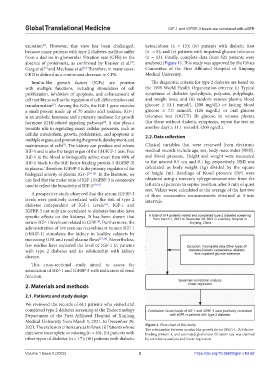
            because many patients with type 2 diabetes mellitus suffer   (n  = 8); and (v) patients with impaired glucose tolerance
            from a decline in glomerular filtration rate (GFR) in the   (n = 13). Finally, complete data from 521  patients were
            absence of proteinuria, as confirmed by Kramer et al. ,   analyzed (Figure 1). This study was approved by the Ethics
                                                        [4]
                    [5]
            Garg et al.  and MacIsaac et al.  Therefore, in many cases,   Committee of the First Affiliated Hospital of Xinjiang
                                     [6]
            CKD is defined as a continuous decrease in GFR.    Medical University.
              Insulin-like growth factors (IGFs) are proteins    The diagnostic criteria for type 2 diabetes are based on
            with multiple functions, including stimulation of cell   the 1999 World Health Organization criteria: (i) Typical
            proliferation, inhibition of apoptosis, and enhancement of   symptoms of diabetes (polydipsia, polyuria, polyphagia,
            cell motility as well as the regulation of cell differentiation and   and weight loss); and (ii) random venous plasma blood
            transformation . Among the IGFs, the IGF-1 gene encodes   glucose ≥ 11.1 mmol/L (200  mg/dL) or fasting blood
                       [7]
            a small protein made up of 70 amino acid residues. IGF-1   glucose ≥ 7.0 mmol/L (126  mg/dL) or oral glucose
            is an anabolic hormone and a primary mediator for growth   tolerance test (OGTT) 2h glucose in venous plasma
            hormone (GH)-related signaling pathways . It also plays a   (for those without diabetic symptoms, repeat the test on
                                             [8]
            versatile role in regulating many cellular processes, such as   another day) ≥ 11.1  mmol/L (200 ng/dL).
            cellular metabolism, growth, proliferation, and apoptosis in   2.2. Data collection
            multiple organs, and promoting the growth, development, and
            maintenance of cells . The kidney can produce and release   Clinical variables that were reviewed from electronic
                            [9]
            IGF-1 and is also the target organ of the GH/IGF-1 axis. Free   medical records include age, sex, body mass index (BMI),
            IGF-1 in the blood is biologically active; more than 90% of   and blood pressure. Height and weight were measured
            IGF-1 binds to the IGF factor-binding protein-3 (IGFBP-3)   to the nearest 0.5 cm and 0.1 kg, respectively. BMI was
            in plasma. Therefore, IGFBP-3 is the primary regulator of the   calculated as body weight (kg) divided by the square
            biological activity of plasma IGF-1 [10-12] . In the literature, we   of  height (m). Readings of  blood pressure  (BP)  were
            can find that the molar ratio of IGF-1/IGFBP-3 is commonly   obtained using a mercury sphygmomanometer from the
            used to reflect the bioactivity of IGF-1 [13,14] .  left arm of patients in supine position, after 5 min of quiet
                                                               rest. Values were calculated as the average of the last two
              A prospective study observed that the serum IGFBP-3   of three consecutive measurements obtained at 3-min
            levels were positively correlated with the risk of type  2   intervals.
            diabetes independent of IGF-1 levels . IGF-1 and
                                             [15]
            IGFBP-3 not only are correlated to diabetes but also have
            specific effects on the kidneys. It has been shown that
            serum IGF-1 levels are related to GFR . Furthermore, the
                                          [16]
            administration of intravenous recombinant human IGF-1
            (rhIGF-1) stimulates the kidney in healthy subjects by
            increasing GFR and renal plasma flows [17,18] . Nevertheless,
            few studies have explored the level of IGF-1 in patients
            with type  2 diabetes and its relationship with kidney
            disease.

              This cross-sectional study aimed to assess the
            association of IGF-1 and IGFBP-3 with indicators of renal
            function.

            2. Materials and methods

            2.1. Patients and study design
            We reviewed the records of 614 patients who visited and
            completed type 2 diabetes screening at the Endocrinology
            Department of the First Affiliated Hospital of Xinjiang
            Medical University from March 1, 2021, to December 20,
            2021. The exclusion criteria are as follows: (i) Patients whose   Figure 1. Flow chart of this study.
                                                               The relationship between insulin-like growth factor (IGF)-1, IGF factor-
            data were incomplete or missing (n = 40); (ii) patients with   binding protein-3, and estimated glomerular filtration rate was clarified
            other types of diabetes (n = 17); (iii) patients with diabetic   by correlation analysis and linear regression.


            Volume 1 Issue 2 (2022)                         2                       https://doi.org/10.36922/gtm.v1i2.62

