


Page 45 - GTM-1-2
P. 45
Global Translational Medicine                                         Cirrhosis and hepatocellular carcinoma


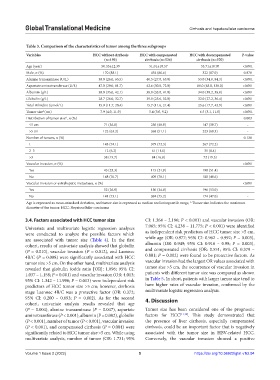
            Table 3. Comparison of the characteristics of tumor among the three subgroups
            Variables                   HCC without cirrhosis  HCC with compensated   HCC with decompensated   P‑value
                                             (n=193)           cirrhosis (n=524)     cirrhosis (n=370)
            Age (year)                      50.35±12.39          51.01±10.57          53.71±10.70       <0.001
            Male, n (%)                      170 (88.1)          454 (86.6)            322 (87.0)        0.878
            Alanine transaminase (U/L)     39.0 (26.0, 65.5)   40.5 (27.0, 65.0)     53.0 (34.0, 84.3)  <0.001
            Aspartate aminotransferase (U/L)  47.0 (29.0, 81.7)  42.6 (30.0, 72.0)   80.0 (48.8, 138.0)  <0.001
            Albumin (g/L)                  39.0 (35.0, 42.1)   38.0 (35.0, 41.0)     34.0 (30.2, 38.0)  <0.001
            Globulin (g/L)                 28.7 (26.0, 32.7)   29.0 (25.6, 32.0)     32.0 (27.2, 36.4)  <0.001
            Total Bilirubin (umol/L)       15.9 (11.7, 20.4)   15.7 (11.6, 21.4)     25.6 (17.7, 42.9)  <0.001
            Tumor size*(cm)                 7.9 (4.0, 11.9)     5.4 (3.0, 9.2)        6.5 (3.1, 11.0)   <0.001
            Distribution of tumor size*, n (%)                                                           0.003
             ≤5 cm                           71 (36.8)           256 (48.9)            147 (39.7)         -
             >5 cm                           122 (63.2)          268 (51.1)            223 (60.3)         -
            Number of tumors, n (%)                                                                      0.130
             1                               143 (74.1)          379 (72.3)            267 (72.2)
             2–3                              12 (6.2)            61 (11.6)             31 (8.4)
             >3                              38 (19.7)            84 (16.0)             72 (19.5)
            Vascular invasion, n (%)                                                                    <0.001
             Yes                             45 (23.3)           115 (21.9)            190 (51.4)
             No                              148 (76.7)          409 (78.1)            180 (48.6)
            Vascular invasion or extrahepatic metastases, n (%)                                         <0.001
             Yes                             52 (26.9)           130 (24.8)            196 (53.0)         -
             No                              141 (73.1)          394 (75.2)            174 (47.0)         -
            Age is expressed as mean±standard deviation, and tumor size is expressed as median and interquartile range, * Tumor size indicates the maximum
            diameter of the tumor. HCC: Hepatocellular carcinoma


            3.4. Factors associated with HCC tumor size        CI: 1.364 – 2.196; P < 0.001) and vascular invasion (OR:
                                                               7.065; 95% CI: 4.238 – 11.775; P < 0.001) were identified
            Univariate and multivariate logistic regression analyses
            were conducted to analyze the possible factors which   as independent risk predictors of HCC tumor size >5 cm,
            are associated with tumor size (Table  4). In the first   while age (OR: 0.977; 95% CI: 0.962 – 0.992; P = 0.003),
            cohort, results of univariate analysis showed that globulin   albumin (OR: 0.949; 95% CI: 0.916 – 0.98;  P = 0.003),
            (P = 0.010), vascular invasion (P = 0.012), and Laennec   and compensated cirrhosis (OR: 0.551; 95% CI: 0.379 –
            4B/C (P = 0.008) were significantly associated with HCC   0.801; P = 0.002) were found to be protective factors. As
            tumor size >5 cm. On the other hand, multivariate analysis   vascular invasion had the largest OR values associated with
            revealed that  globulin  (odds  ratio  [OR]:  1.096;  95% CI:   tumor size >5 cm, the occurrence of vascular invasion in
            1.037 – 1.158; P = 0.001) and vascular invasion (OR: 4.013;   patients with different tumor size was compared as shown
            95% CI: 1.342 – 11.996; P = 0.013) were independent risk   in Table 5. In short, patients with larger tumor size tend to
            predictors of HCC tumor size >5 cm; however, cirrhosis   have higher rates of vascular invasion, confirmed by the
            stage Laennec 4B/C was a protective factor (OR: 0.372;   multivariate logistic regression analysis.
            95%  CI:  0.200  –  0.693;  P  =  0.002).  As  for  the  second   4. Discussion
            cohort, univariate analysis results revealed that age
            (P = 0.004), alanine transaminase (P = 0.047), aspartate   Tumor size has been considered one of the prognostic
            aminotransferase (P < 0.001), albumin (P = 0.002), globulin   factors for HCC [11,12] . This study demonstrated that
            (P < 0.001), number of tumor (P < 0.001), vascular invasion   the presence of liver cirrhosis, especially compensated
            (P < 0.001), and compensated cirrhosis (P = 0.004) were   cirrhosis, could be an important factor that is negatively
            significantly related to HCC tumor size >5 cm. While using   associated  with  the  tumor  size  in  HBV-related  HCC.
            multivariate analysis, number of tumor (OR: 1.731; 95%   Conversely, the vascular invasion showed a positive


            Volume 1 Issue 2 (2022)                         5                       https://doi.org/10.36922/gtm.v1i2.94

