


Page 43 - GTM-1-2
P. 43
Global Translational Medicine                                         Cirrhosis and hepatocellular carcinoma


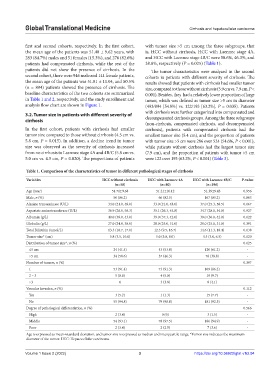
            first and second cohorts, respectively. In the first cohort,   with tumor size >5 cm among the three subgroups, that
            the mean age of the patients was 51.40 ± 9.62 years, with   is, HCC without cirrhosis, HCC with Laennec stage 4A,
            283 (84.7%) males and 51 females (15.3%), and 276 (82.6%)   and HCC with Laennec stage 4B/C were 58.6%, 46.3%, and
            patients had compensated cirrhosis, while the rest of the   38.8%, respectively (P = 0.025) (Table 1).
            patients did not show the presence of cirrhosis. In the   The tumor characteristics were analyzed in the second
            second cohort, there were 946 male and 141 female patients,   cohorts in patients with different severity of cirrhosis. The
            the mean age of the patients was 51.81 ± 11.04, and 80.5%   results showed that patients with cirrhosis had smaller tumor
            (n = 894) patients showed the presence of cirrhosis. The   size, compared to those without cirrhosis (5.9 cm vs. 7.9 cm, P <
            baseline characteristics of the two cohorts are summarized   0.001). Besides, they  had a relatively lower proportion of large
            in Table 1 and 2, respectively, and the study enrollment and   tumor, which was defined as tumor size >5 cm in diameter
            analysis flow chart are shown in Figure 1.         (493/894 [54.9%] vs. 122/193 [63.2%], P = 0.035). Patients
                                                               with cirrhosis were further categorized into compensated and
            3.2. Tumor size in patients with different severity of
            cirrhosis                                          decompensated cirrhosis groups. Among the three subgroups
                                                               (non-cirrhosis, compensated cirrhosis, and decompensated
            In the first cohort, patients with cirrhosis had smaller   cirrhosis), patients with compensated cirrhosis had the
            tumor size compared to those without cirrhosis (4.5 cm vs.   smallest tumor size (5.4 cm), and the proportion of patients
            5.8 cm, P = 0.015). In addition, a decline trend in tumor   with tumor size >5 cm were 286 over 524 (54.6%, P < 0.001),
            size was observed as the severity of cirrhosis increased   while patients without cirrhosis had the largest tumor size
            from no cirrhosis to Laennec stage 4A and 4B/C (5.8 cm vs.   (7.9 cm), and the proportion of patients with tumor >5 cm
            5.0 cm vs. 4.5 cm, P = 0.020). The proportions of patients   were 122 over 193 (63.2%, P < 0.001) (Table 3).


            Table 1. Comparison of the characteristics of tumor in different pathological stages of cirrhosis
            Variables                        HCC without cirrhosis  HCC with Laennec 4A  HCC with Laennec 4B/C  P‑value
                                                  (n=58)             (n=80)              (n=196)
            Age (year)                           51.71±9.68        51.21±10.12          51.39±9.43       0.956
            Male, n (%)                          50 (86.2)           66 (82.5)          167 (85.2)       0.803
            Alanine transaminase (U/L)         34.0 (21.0, 48.0)  33.0 (21.0, 48.0)   37.0 (25.3, 58.5)  0.067
            Aspartate aminotransferase (U/L)   36.9 (26.0, 56.3)  35.1 (26.3, 44.8)   34.7 (28.0, 54.0)  0.927
            Albumin (g/L)                      40.0 (38.0, 43.0)  39.0 (37.3, 42.0)   39.0 (36.0, 42.0)  0.022
            Globulin (g/L)                     27.0 (24.8, 30.0)  28.0 (25.0, 31.0)   28.0 (25.0, 31.0)  0.391
            Total Bilirubin (umol/L)           13.3 (10.7, 17.8)   12.3 (9.5, 16.7)   14.6 (11.3, 18.4)  0.038
            Tumor size* (cm)                    5.8 (3.5, 10.0)    5.0 (3.0, 8.0)      4.5 (3.0, 6.5)    0.020
            Distribution of tumor size*, n (%)                                                           0.025
             ≤5 cm                               24 (41.4)           43 (53.8)          120 (61.2)        -
             >5 cm                               34 (58.6)           37 (46.3)          76 (38.8)         -
            Number of tumors, n (%)                                                                      0.397
             1                                   53 (91.4)           73 (91.3)          169 (86.2)
             2 – 3                                5 (8.6)            4 (5.0)             19 (9.7)
             >3                                     0                3 (3.8)             8 (4.1)
            Vascular invasion, n (%)                                                                     0.112
             Yes                                  3 (5.2)            1 (1.3)             15 (7.7)         -
             No                                  55 (94.8)           79 (98.8)          181 (92.3)        -
            Degree of pathological differentiation, n (%)                                                0.566
             High                                 2 (3.4)             0 (0)              3 (1.5)          -
             Middle                              54 (93.1)           78 (97.5)          186 (94.9)        -
             Poor                                 2 (3.4)            2 (2.5)             7 (3.6)          -
            Age is expressed as mean±standard deviation, and tumor size is expressed as median and interquartile range. *Tumor size indicates the maximum
            diameter of the tumor. HCC: Hepatocellular carcinoma


            Volume 1 Issue 2 (2022)                         3                       https://doi.org/10.36922/gtm.v1i2.94

