


Page 46 - GTM-1-2
P. 46
Global Translational Medicine                                         Cirrhosis and hepatocellular carcinoma


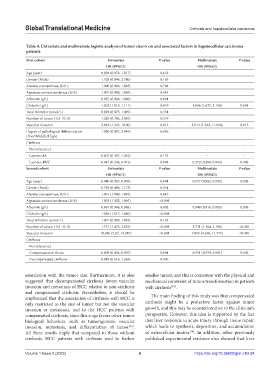
            Table 4. Univariate and multivariate logistic analysis of tumor size>5 cm and associated factors in hepatocellular carcinoma
            patients
            First cohort                       Univariate           P‑value          Multivariate     P‑value
                                              OR (95%CI)                             OR (95%CI)
            Age (year)                      0.994 (0.972, 1.017)     0.618
            Gender (Male)                   1.528 (0.840, 2.780)     0.165
            Alanine transaminase (U/L)      1.000 (0.996, 1.003)     0.768
            Aspartate aminotransferase (U/L)  1.001 (0.998, 1.004)   0.543
            Albumin (g/L)                   0.955 (0.906, 1.008)     0.094
            Globulin (g/L)                  1.062 (1.015, 1.111)     0.010         1.096 (1.037, 1.158)  0.001
            Total Bilirubin (umol/L)        0.992 (0.975, 1.009)     0.354
            Number of tumor (1/2–3/>3)      1.283 (0.786, 2.095)     0.319
            Vascular invasion               3.832 (1.347, 10.90)     0.012         4.013 (1.342, 11.996)  0.013
            Degree of pathological differentiation   1.096 (0.407, 2.949)  0.856
            (Poor/Middle/High)
            Cirrhosis
             No (reference)                       -                    -                 -               -
             Laennec 4A                     0.607 (0.307, 1.202)     0.152               -               -
             Laennec 4B/C                   0.447 (0.246, 0.812)     0.008         0.372 (0.200, 0.693)  0.002
            Second cohort                      Univariate           P‑value          Multivariate     P‑value
                                              OR (95%CI)                             OR (95%CI)
            Age (year)                      0.980 (0.967, 0.994)     0.004         0.977 (0.962, 0.992)  0.003
            Gender (Male)                   0.758 (0.490, 1.173)     0.214
            Alanine transaminase (U/L)      1.001 (1.000, 1.002)     0.047
            Aspartate aminotransferase (U/L)  1.003 (1.002, 1.005)   <0.001
            Albumin (g/L)                   0.967 (0.946, 0.988)     0.002         0.949 (0.916, 0.983)  0.003
            Globulin (g/L)                  1.038 (1.017, 1.060)     <0.001
            Total Bilirubin (umol/L)        1.001 (0.999, 1.003)     0.192
            Number of tumor (1/2–3/>3)      1.751 (1.475, 2.078)     <0.001        1.731 (1.364, 2.196)  <0.001
            Vascular invasion               10.056 (7.07, 14.287)    <0.001        7.065 (4.238, 11.775)  <0.001
            Cirrhosis
             No (reference)                       -                    -                 -               -
             Compensated cirrhosis          0.609 (0.434, 0.855)     0.004         0.551 (0.379, 0.801)  0.002
             Decompensated cirrhosis        0.883 (0.616, 1.264)     0.496


            association with the tumor size. Furthermore, it is also   smaller tumor, and this is consistent with the physical and
            suggested that decompensated cirrhosis favors vascular   mechanical constraint of tumor transformation in patients
            invasion and metastasis of HCC relative to non-cirrhosis   with cirrhosis .
                                                                          [10]
            and compensated cirrhosis. Nevertheless, it should be
            emphasized that the association of cirrhosis with HCC is   The main finding of this study was that compensated
            only restricted to the size of tumor but not the vascular   cirrhosis might be a protective factor against tumor
            invasion or metastasis, and to the HCC patients with   growth, and this may be counterintuitive to the clinician’s
            compensated cirrhosis, since this stage favors other tumor   perspective. However, this idea is supported by the fact
            biological behaviors, such as tumorigenesis, vascular   that liver responds to acute injury through tissue repair,
            invasion, metastasis, and differentiation of tumor .   which leads to synthesis, deposition, and accumulation
                                                        [13]
                                                                                  [14]
            All these results imply that compared to those without   of  extracellular  matrix .  In addition,  other  previously
            cirrhosis, HCC patients with cirrhosis tend to harbor   published experimental evidence also showed that liver

            Volume 1 Issue 2 (2022)                         6                       https://doi.org/10.36922/gtm.v1i2.94

