


Page 51 - GTM-1-2
P. 51
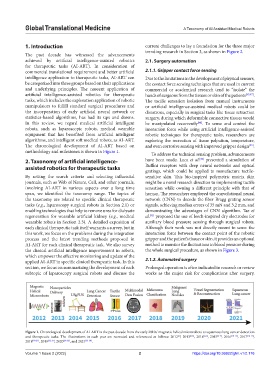
Global Translational Medicine                                      A Taxonomy of AI Assisted Medical Robots


            1. Introduction                                    current challenges to lay a foundation for the three major
                                                               trending research in Section 3, as shown in Figure 2.
            The past decade has witnessed the advancements
            achieved by artificial intelligence-assisted robotics   2.1. Surgery automation
            for therapeutic tasks (AI-ART). In consideration of
            commercial translational requirement and better artificial   2.1.1. Gripper contact force sensing
            intelligence application to therapeutic tasks, AI-ART can   Due to the limitations in the development of physical sensors,
            be categorized into three groups based on their applications   the contact force sensing techniques that are used in current
            and underlying  principles.  The  nascent application  of   commercial or academical research tend to “isolate” the
            artificial intelligence-assisted robotics for therapeutic   hands of surgeons from the tissues or skin of the patients [45,47] .
            tasks, which includes the exploration application of robotic   The tactile sensation isolation from manual instruments
            manipulators to fulfill standard surgical procedures and   or artificial intelligence-assisted medical robots could be
            the incorporation of early artificial neural network or   disastrous, especially in surgical tasks like tissue retraction
            statistics-based algorithms, has had its ups and downs.   surgery, during which deformable connective tissues would
            In this review, we regard medical artificial intelligent   be manipulated recurrently . To sense and control the
                                                                                     [48]
            robots, such as laparoscopic robots, medical wearable   interaction force while using artificial intelligence-assisted
            equipment that has benefited from artificial intelligent   robotic techniques for therapeutic tasks, researchers are
            algorithms, and intelligent soft medical robots, as AI-ART.   exploring the recreation of tissue palpation, temperature,
            The chronological development of AI-ART based on   and even corrosive sensing with improved gripper design .
                                                                                                           [49]
            methodology and milestones is shown in Figure 1.
                                                                 To address the technical sensing problem, advancements
                                                                                      [50]
            2. Taxonomy of artificial intelligence-            have been made. Luca  et al.  presented a simulation of
            assisted robotics for therapeutic tasks            Ruffini  receptors  with  deep  neural  networks  and  optical
                                                               gratings, which could be applied to manufacture tactile-
            By setting the search criteria and selecting influential   sensitive skin. This bio-inspired polymetric matrix skin
            journals, such as Web of Nature, Cell, and other journals,   might be a novel research direction to implementing tactile
            involving  AI-ART  in  various  aspects  over  a  long time   sensation while owning a different principle with that of
            span, we identified the taxonomy range. The topics of   human. The researchers employed the convolutional neural
            the taxonomy are related to specific clinical therapeutic   network (CNN) to decode the fiber Bragg grating sensor
            tasks (e.g., laparoscopy surgical robots in Section 2.1) or   signals, achieving median errors of 35 mN and 3.2 mm, and
            enabling technologies that help to remove urea for dialysate   demonstrating the advantages of CNN algorithm. Tae  et
            regeneration for wearable artificial kidney (e.g., medical   al.  proposed the use of leech-inspired dry electrodes for
                                                                 [51]
            wearable robots in Section 2.3). A detailed exposition of   auxiliary blood pressure sensing through surgical robots.
            each clinical therapeutic task itself warrants a survey, but in   Although their work was not directly meant to sense the
            this work, we focus on the problems during the integration   interaction force between the contact point of the robotic
            process and the latest trending methods proposed in   gripper and the patient’s tissue or skin, it provides an optional
            AI-ART for each clinical therapeutic task. We also survey   method to monitor the fluctuations in blood pressure during
            the clinical artificial intelligence improvement in robots,   the whole surgical procedure, as shown in Figure 3.
            which empower the effective monitoring and update of the
            applied AI-ART in specific clinical therapeutic task. In this   2.1.2. Automated surgery
            section, we focus on summarizing the development of each   Prolonged operation is often indicated in research or review
            subtopic of laparoscopy surgical robots and discuss the   works as the major risk for complications after surgery.


            Figure 1. Chronological development of AI-ART in the past decade from the early 2010s’ magnetic helical microrobots to squamous lung cancer detection
            and therapeutic tasks. The illustrations in each year are recreated and referenced as follows: 2012 , 2013 [2,3] , 2014 [4,5] , 2015 [6-9] , 2016 [10-13] , 2017 [14-17] ,
                                                                             [1]
            2018 [18-21] , 2019 [22-27] , 2020 [28-32] , and 2021 [33-38] .
            Volume 1 Issue 2 (2022)                         2                      https://doi.org/10.36922/gtm.v1i2.176

