


Page 54 - GTM-1-2
P. 54
Global Translational Medicine                                      A Taxonomy of AI Assisted Medical Robots


            recovery. Another reason for its popularity is an increasing   magnetic actuator depend on the natural opening of the
            proportion of the elderly. The elderly has a weaker   intestine or stomach, which is dynamic and continuously
            immunity and wound healing ability than the young.   changing along with the heartbeat and respiration. Hence,
            Therefore, it is crucial to invest energy and money in MIS   a reliable support structure is needed for endoluminal
            now and in the future. We have witnessed the progress   robots to obtain better imaging of its surroundings deep
            made by researchers in MIS in recent years; the seminal   inside the human body. At present, self-propelling robots
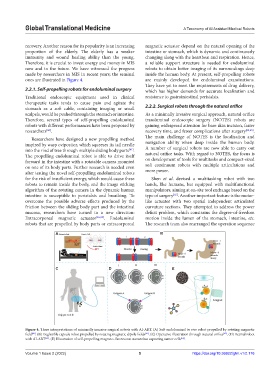
            ones are illustrated in Figure 4.                  are mainly developed for endoluminal examinations.
                                                               They have yet to meet the requirements of drug delivery,
            2.2.1. Self-propelling robots for endoluminal surgery  which has higher demands for accurate localization and
            Traditional endoscopic equipment used in clinical   resistance to gastrointestinal peristalsis.
            therapeutic tasks tends to cause pain and agitate the
            stomach as a soft cable, containing imaging or small   2.2.2. Surgical robots through the natural orifice
            scalpels, would be pushed through the stomach or intestine.   As a minimally invasive surgical approach, natural orifice
            Therefore, several types of self-propelling endoluminal   transluminal endoscopic surgery (NOTES) robots are
            robots with different performances have been proposed by   gaining widespread attention for bare skin incision, faster
            researchers .                                      recovery time, and fewer complications after surgery [62,65] .
                     [60]
              Researchers have designed a new propelling method   The main challenge of NOTES is the localization and
            inspired by wasp ovipositor, which squeezes its tail needle   navigation  ability  when  deep  inside  the  human  body.
            into the rind of tree through multiple sliding body parts .   A  number of surgical robots are now able to carry out
                                                        [61]
            The propelling endoluminal robot is able to drive itself   natural orifice tasks. With regard to NOTES, the focus is
            forward in the intestine with a rotatable camera mounted   on development of tools for multitasks and compact-sized
            on one of its body parts. Further research is needed even   soft continuum robots with multiple articulations and
            after testing the novel self-propelling endoluminal robots   more power.
            for the risk of insufficient energy, which would cause these   Shen  et al. devised a multitasking robot with two
            robots to remain inside the body, and the image sticking   hands, like humans, but equipped with multifunctional
            algorithm of the rotating camera in the dynamic human   manipulators, aiming at on-site tool exchange based on the
            intestine is susceptible to peristalsis and breathing. To   type of surgery . Another important feature is the motor-
                                                                           [65]
            overcome the possible adverse effects produced by the   like actuator with two spatial independent articulated
            friction between the sliding body part and the intestinal   curvature sections. They attempted to address the power
            mucosa, researchers have turned to a new direction:   deficit problem, which constrains the degree-of-freedom
            Extracorporeal magnetic actuator [46,62] . Endoluminal   motion  inside  the  lumen  of the  stomach,  intestine,  etc.
            robots that are propelled by body parts or extracorporeal   The research team also rearranged the operation sequence
                         A                                           B


                         C                     D                          E


            Figure 4. Three interpretations of minimally invasive surgical robots with AI-ART. (A) Soft endoluminal in vivo robot propelled by rotating magnetic
            field . (B) Deglutible capsule robot propelled by rotating magnetic dipole fields . (C) Operative illustration through natural orifice . (D) Retinal robot
                                                                                                [62]
                                                               [61]
               [60]
            with AI-ART . (E) Illustration of self-propelling magneto-fluorescent nanorobot capturing tumor cells .
                                                                              [64]
                    [63]
            Volume 1 Issue 2 (2022)                         5                      https://doi.org/10.36922/gtm.v1i2.176

