


Page 59 - GTM-1-2
P. 59
Global Translational Medicine                                      A Taxonomy of AI Assisted Medical Robots


                         A                                 B


                         C                                   D


                                                                                [76]
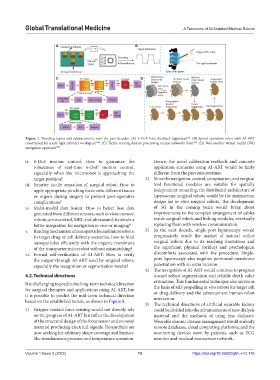
            Figure 7. Trending topics and advancements over the past decades. (A) 3-DoF force feedback apparatus . (B) Spinal operation robot with AI-ART
                                          [78]
                                                                                   [50]
            constrained by a safe light cylinder workspace . (C) Tactile sensing feature processing neural networks from . (D) Non-marker virtual reality (VR)
            navigation approach .
                         [57]
            ii.  6-DoF motion control: How to guarantee the       Hence, the novel calibration methods and concrete
               robustness of real-time 6-DoF motion control,      application scenarios using AI-ART would be fairly
               especially when the microrobot is approaching the   different from the previous routines.
               target position?                                2)  Since the navigation, control, computation, and surgical
            iii.  Smarter tactile sensation of surgical robot: How to   tool functional modules are suitable for spatially
               apply appropriate pinching force onto different tissues   independent mounting, the distributed architecture of
               or organs during surgery to prevent post-operative   laparoscopy surgical robots would be the mainstream
               complications?                                     design for  in vitro surgical robots. The development
            iv.  Multi-modal data fusion: How to better fuse data   of 5G in the coming years would bring about
               generated from different sensors, such as vision sensor,   improvements to the complex arrangement of cables
               robotic arms control, MRI, and ultrasound, to obtain a   inside surgical robots and linking modules, eventually
               better integration for navigation in vivo or imaging?  replacing them with wireless communication.
            v.  Binding mechanism of nanoparticles and microrobots:   3)  In the next decade, single-port laparoscopy would
               In target drug or cell delivery scenarios, how to bind   progressively erode the market of natural orifice
               nanoparticles efficiently with the organic membrane   surgical robots due to its reaching limitations and
               of the transporter microrobot without mismatching?  the significant physical (orifice) and psychological
            vi.  Formal  self-verification of  AI-ART:  How to  verify   discomforts associated with the procedure. Single-
               the output through AI-ART used by surgical robots,   port laparoscopy also requires peritoneal membrane
               especially the recognition or segmentation results?  penetration with an extra incision.
                                                               4)  The navigation of AI-ART would continue to progress
            4.2. Technical directions                             toward robust segmentation and reliable depth value
                                                                  estimation. This fundamental technique also serves as
            It is challenging to predict the long-term technical direction
            for surgical therapies and applications using AI-ART, but   the basis of self-propelling in vivo robots for target cell
            it is possible to predict the mid-term technical direction   or drug delivery and the advancement human-robot
            based on the established trends, as shown in Figure 8.  interaction.
                                                               5)  The technical directions of artificial wearable kidney
            1)  Gripper contact force sensing would not directly rely   could be divided into the advancements of new dialysis
               on the progress of AI-ART but rather the development   material and the methods of using less dialysate.
               of the structural design of the force sensor and on novel   Wearable chronic disease management would embody
               material producing electrical signals. Researchers are   remote databases, cloud computing platforms, and the
               now seeking for arbitrary shape coverage and human-  monitoring devices worn by patients, such as ECG
               like simultaneous pressure and temperature sensation.   monitor and medical nanosensor network.


            Volume 1 Issue 2 (2022)                         10                     https://doi.org/10.36922/gtm.v1i2.176

