


Page 57 - GTM-1-2
P. 57
Global Translational Medicine                                      A Taxonomy of AI Assisted Medical Robots


            a wearable artificial kidney, the patient may not have access   3.1. Feedback of tactile sensation
            to dialysis storage or caregiver at any time .     The application of either classic laparoscopy or AI-ART for
                                             [70]
              The main direction is the study of sorbent adsorption,   medical robots isolates the surgeon’s tactile sensation from
            in which highly effective activated charcoals can inherently   the patient’s deformable tissue or skin. However, either
            absorb uremic toxins. Historically, the exclusive sorbents   the  surgical  robot  with  on-site  surgeons  or  telesurgery
            system has been proven ineffective in binding and eliminating   through 5G communication technologies is required to
            urea. Hence, researchers have developed five types of sorbents,   hold or pull the tissue with proper force without secondary
            to the best of our knowledge, for urea adsorption. One of the   classic laparoscopic injury. Researchers have explored new
            five types includes TPA-COF (covalent organic framework)   sensation technologies for the interaction between medical
            nanosheets and TPA-COF nanoparticle modified with -OH,   robots and soft tissue . The fundamental work of AI-ART
                                                                                [76]
            which have been verified to have better urea adsorption based   for medical robots is undoubtedly the calibration of force
            on molecular study. Other directions of wearable artificial   sensor or torque sensor, which transforms raw electrical
            kidney include enzymatic removal of urea, electro-oxidation,   signal into force or torque values with real physical
            photo-oxidation, blood compatibility, and human factors .   meaning. With regard to the progress of calibration,
                                                        [69]
            Artificial intelligence-assisted analysis would improve the   the main focus is on end-to-end neural networks as the
            search for more efficient materials relating to the development   multi-axis data and their mutual coupling. Deep learning
            of sorbents in three aspects: (1) Effective combination of   algorithms have been leveraged for the calibration of force
            candidate structures; (2) more reliable dynamics simulation   and torque sensors. On the basis of calibration works, the
            for liquid circuit system; and (3) accurate prediction of the   skin-like sensor that is able to attach to arbitrary surface has
            recharge of consumable materials.                  drawn interests, as it can be manufactured into non-array

            3. Human-robot interaction for automation          arrangement as well as sense and transmit signals even
                                                               with partial damages. Four artificial neural networks have
            or telesurgery                                     been adopted to determine their slippage and accuracy data
            We searched Nature, Cell, and Science website pages using   output as well as compared for cross-verification, with their
                                                                                 [50]
            keywords “medical artificial intelligent robots” to index all   weaknesses illustrated . Generative adversarial network
            the related papers with a time range from 1990s to the latest   (GAN) learning algorithms and its variants as GAN exploits
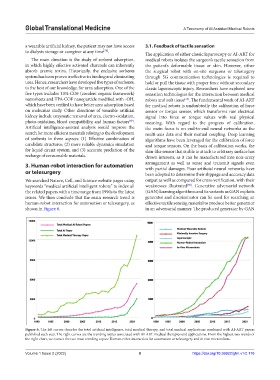
            issues. We then conclude that the main research trend is   generator and discriminator can be used for searching an
            human-robot interaction for automation or telesurgery, as   effective tactile sensing material to produce better generator
            shown in Figure 6.                                 in an adversarial manner. The produced generator by GAN


            Figure 6. The left curves describe the total artificial intelligence, total medical therapy, and total medical applications combined with AI-ART papers
            published each year. The right curves are the trending topics associated with AI-ART medical therapies and applications. From the highest two trends of
            the right chart, we extract the two most trending topics: Human-robot interaction for automation or telesurgery and in vivo microrobots.


            Volume 1 Issue 2 (2022)                         8                      https://doi.org/10.36922/gtm.v1i2.176

