


Page 70 - GTM-1-2
P. 70
Global Translational Medicine                                      Risk factors of idiopathic pulmonary fibrosis


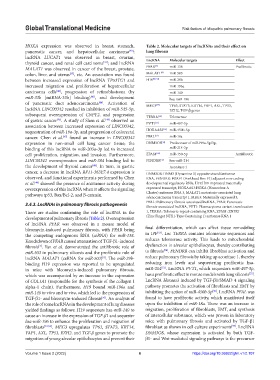
            HOXA expression was observed in breast, stomach,   Table 2. Molecular targets of lncRNAs and their effect on
            pancreatic cancer, and hepatocellular carcinoma ;   lung fibrosis
                                                        [40]
            lncRNA  LUCAT1  was observed in  breast,  ovarian,   LncRNA  Molecular targets           Effect
            thyroid cancer, and renal cell carcinoma ; and lncRNA
                                             [41]
            MALAT1 was observed in cancer of the breast, prostate,   PFAR [3]  miR-138               Profibrotic
            colon, liver, and uterus , etc. An association was found   MALAT1 [4]  miR-503
                               [37]
            between increased expression  of lncRNA  TP53TG1 and   Н19 [50-52]  miR-29b
            increased migration and proliferation of hepatocellular      miR-196a
            carcinoma cells , progression of retinoblastoma (by          miR-140
                         [42]
            miR-33b [miRNA-33b] binding) , and development               hsa-miR-196
                                        [43]
            of pancreatic duct adenocarcinoma . Activation of   MEG3 [53]  TP63, STAT3, KRT14, YAP1, AXL, TP53,
                                           [44]
            lncRNA LINC00342 resulted in inhibition of miR-545-5p,       EZH2, TGF-β genes
            subsequent overexpression of  CNPY2, and progression   TERRA [54]  Telomerase
            of gastric cancer . A study of Shen et al.  observed an   [55]
                         [45]
                                              [46]
            association between increased expression of LINC00342,   PVT1  miR-497-5p
            sequestration of miR-19a-3p, and progression of colorectal   HOXAAS3 [56]  miR-450b-5p
            cancer. Chen  et al.  found an increase in  LINC00342   PFAL [57]  miR-18a
                            [47]
            expression  in  non-small  cell  lung  cancer  tissue;  the   DNM3OS [58]  Predecessor of miR199a-5p/3p,
            binding of this lncRNA to miR-203a-3p led to increased       miR-214-3p
            cell proliferation, migration, and invasion. Furthermore,   ZFAS1 [59]  miR-150-5p       Antifibrotic
            LINC00342 overexpression and  miR-384 binding led to   FENDRR [51]  hsa-miR-214
                                        [48]
            the development of thyroid cancer . In turn, in gastric      Aconitase 1
            cancer, a decrease in lncRNA RP11-363E7.4 expression is   DNM3OS: DNM3 (Dynamine 3) opposite strand/antisense
            observed, and functional experiments performed by Chen   RNA, FENDRR: FOXF1 (Forkhead Box F1) adjacent non-coding
            et al.  showed the presence of antitumor activity during   developmental regulatory RNA, H19:H19 imprinted maternally
                [49]
            overexpression of this lncRNA when it affects the signaling   expressed transcript, HOXAAS3:HOXA (Homeobox A
            pathways tp53, Bax/Bcl-2, and β-catenin.           Cluster) antisense RNA 3, MALAT1:metastasis-associated lung
                                                               adenocarcinoma transcript 1, MEG3: Maternally expressed 3,
            3.4.3. LncRNAs in pulmonary fibrosis pathogenesis  PFAL: Pulmonary fibrosis-associated lncRNA, PFAR: Pancreatic
                                                               fibrosis-associated lncRNA, PVT1: Plasmacytoma variant translocation
            There are studies confirming the role of lncRNA in the   1, TERRA: Telomeric-repeat-containing RNA, ZFAS1: ZNFX1
            development of pulmonary fibrosis (Table 2). Overexpression   (Zinc Finger NFX1-Type Containing 1) antisense RNA 1
            of lncRNA  PFAR was observed in a mouse model of
            bleomycin-induced pulmonary fibrosis, with  PFAR being   final differentiation, which can affect tissue remodeling
                                                                    [53]
            the competing endogenous RNA (ceRNA) for  miR-138.   in IPF . Lnc TERRA contains telomerase sequences and
            Knockdown of PFAR caused attenuation of  TGF-β1-induced   reduces telomerase activity.  This  leads  to mitochondrial
            fibrosis .  Yan  et al.  demonstrated  the  antifibrotic  role  of   dysfunction in alveolar epitheliocytes, thereby contributing
                 [3]
                                                                       [54]
            miR-503 in pulmonary silicosis and the profibrotic role of   to fibrosis . FENDRR can inhibit fibroblast activation and
            lncRNA  MALAT1 (ceRNA for  miR-503) . The  miR-29b-  reduce pulmonary fibrosis by taking up aconitase 1, thereby
                                             [4]
            binding  H19  expression  was  reported  to  be  upregulated   reducing  iron levels  and  sequestering profibrotic  hsa-
                                                                      [51]
            in mice with bleomycin-induced pulmonary fibrosis,   miR-214 . LncRNA PVT1, which sequesters miR-497-5p,
                                                                                                           [55]
            which was accompanied by an increase in the expression   has a profibrotic effect in mouse models with lung silicosis .
            of COL1A1 (responsible for the synthesis of the collagen I   LncRNA Hoxaas3 induced by TGF-β1/SMAD 4 signaling
            alpha-1 chain).  Furthermore,  H19  bound  miR-196a  and   pathway promotes the activation of fibroblasts and EMT by
                                                                                           [56]
            miR-140 in vitro and in vivo, which led to the progression of   inhibiting the action of miR-450b-5p . LncRNA PFAL was
            TGF-β1- and bleomycin-induced fibrosis . An analysis of   found to have profibrotic activity, which manifested itself
                                            [50]
            the role of some lncRNAs in the development of lung diseases   upon the inhibition of miR-18a. There was an increase in
            yielded findings as follows: H19 sequesters hsa-miR-140 to   migration, proliferation of fibroblasts, EMT, and synthesis
            cause an increase in the expression of TGF-β1 and sequester   of intercellular substance, which was proven in laboratory
            hsa-miR-196 to enhance the proliferation and migration of   mice with pulmonary fibrosis and activated by TGF-β1
            fibroblasts [51,52] .  MEG3 upregulates  TP63, STAT3, KRT14,   fibroblast as shown in cell culture experiments . LncRNA
                                                                                                   [57]
            YAP1, AXL, TP53, EZH2, and TGF-β genes to promote the   DNM3OS,  whose  expression  is  activated  by  both  TGF-
            migration of young alveolar epitheliocytes and prevent their   β1- and Wnt-mediated signaling pathways is the precursor


            Volume 1 Issue 2 (2022)                         6                      https://doi.org/10.36922/gtm.v1i2.107

