


Page 68 - GTM-1-2
P. 68
Global Translational Medicine                                      Risk factors of idiopathic pulmonary fibrosis


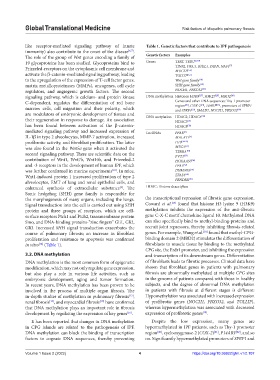
            like receptor-mediated signaling pathway of innate   Table 1. Genetic factors that contribute to IPF pathogenesis
            immunity) also contribute to the onset of the disease [6,7] .
            The role of the group of Wnt genes encoding a family of   Genetic factors  Examples
            19 glycoproteins has been studied. Glycoproteins bind to   Genes  TERT, TERC [1,5-7]   [7]
            Frizzeled-receptors on the cytoplasmic cell membrane and        TINF2, DKC1, RTEL1, PARN, NAF1
                                                                            MUC5B
                                                                                 [5,6]
            activate the β-catenin-mediated signaling pathway, leading      TOLLIP [6,7]
            to the upregulation of the expression of T-cell factor genes,   Wnt gene family [10]
            matrix metalloproteinases (MMPs), oncogenes, cell cycle         SHH gene family [12]
            regulators, and angiogenic growth factors. The second           NOCH1, FBXO32 [19]
                                                                                             [25]
                                                                                      [17]
            signaling pathway, which is calcium- and protein kinase   DNA methylation Histones: H3K9 , H3K27 , MBD2 [18]
            C-dependent, regulates the differentiation of red bone          Genes and other DNA sequences: Thy-1 promoter
                                                                            region , COX-2 , 14ARF , promoters of SFRP1
                                                                                             [22]
                                                                                [20]
                                                                                      [21]
            marrow cells, cell migration and their polarity, which          and SFRP4 , SMAD7, NOCH1, FBXO32 [19]
                                                                                  [23]
            are modulators of embryonic development of tissues and   DNA acetylation HDAC2, HDAC4 [30]
            their regeneration in response to damage. An association        HDAC3 [31]
            has been found between activation of the  β-catenin-            HDAC8 [32]
            mediated signaling pathway and increased expression of   LncRNAs  PFAR [3]
            IL-1β in type 2 alveolocytes, MMP-7 activation, increased       MALAT1 [4]
            profibrotic activity, and fibroblast proliferation. The latter   Н19 [50-52]
            was also found in the Wnt5a gene when it activated the          MEG3 [53] [54]
            second signaling pathway. There are scientific data on the      TERRA
                                                                               [55]
                                                                            PVT1
            contribution of Wnt1, Wnt7b, Wnt10b, and Frizzeled-2            HOXAAS3 [56]
            and -3 receptors in the development of human IPF, which         PFAL [57]
            was further confirmed in murine experiments . In mice,          DNM3OS [58]
                                                 [10]
            Wnt1-induced protein 1 increased proliferation of type 2        ZFAS1 [59] [51]
            alveolocytes, EMT of lung and renal epithelial cells, and       FENDRR
            enhanced synthesis of extracellular substance . The   HDAC: Histone deacetylase
                                                    [1]
            Sonic hedgehog  (SHH) gene family is responsible for
            the morphogenesis of many organs, including the lungs.   the transcriptional repression of fibrotic gene expression.
                                                                          [17]
            Signal transduction into the cell is carried out using SHH   Coward  et al.  found that histone H3 lysine 9 (H3K9)
            protein and three groups of receptors, which are cell-  methylation inhibits the expression of the anti-fibrotic
            surface receptors Ptch1 and Ptch2, transmembrane protein   gene C-X-C motif chemokine ligand 10. Methylated DNA
            Smo, and DNA-binding proteins-“zinc fingers” Gli1, Gli2,   can also specifically bind to methyl-binding-proteins and
            Gli3. Increased SHH signal transduction exacerbates the   recruit joint repressors, thereby inhibiting fibrosis-related
                                                                                       [18]
            course of pulmonary fibrosis; an increase in fibroblast   genes. For example, Wang et al.  found that methyl-CPG-
            proliferation and resistance to apoptosis was confirmed   binding domain 2 (MBD2) stimulates the differentiation of
            in vitro  (Table 1).                               fibroblasts to muscle tissue by binding to the methylated
                  [12]
                                                               CPG site, the Erdr1 promoter, and inhibiting the expression
            3.2. DNA methylation                               and transcription of its downstream genes. Differentiation
            DNA methylation is the most common form of epigenetic   of fibroblasts leads to fibrotic processes. Clinical data have
            modification, which may not only regulate gene expression,   shown that fibroblast genes in patients with pulmonary
            but also play a role in various life activities, such as   fibrosis are abnormally methylated at multiple CPG sites
            embryonic development, aging and tumor formation.   in the genome of patients compared with those in healthy
            In recent years, DNA methylation has been proven to be   subjects, and the degree of abnormal DNA methylation
            involved in the process of multiple organ fibrosis. The   in patients with fibrosis at different stages is different:
            in-depth studies of methylation in pulmonary fibrosis ,   Hypomethylation was associated with increased expression
                                                        [13]
            renal fibrosis , and myocardial fibrosis  have confirmed   of profibrotic genes (NOCH1,  FBXO32, and  TOLLIP),
                                           [15]
                      [14]
            that DNA methylation plays an important role in fibrosis   whereas hypermethylation was associated with decreased
                                                                                       [19]
                                                       [16]
            development by regulating the expression of key genes .  expression of profibrotic genes .
              It has been reported that changes in DNA methylation   Despite the low expression, many genes are
            in CPG islands are related to the pathogenesis of IPF.   hypermethylated in IPF patients, such as Thy-1 promoter
                                                                                            [21]
            DNA methylation can block the binding of transcription   region , cyclooxygenase-2 (COX-2) , P14ARF , and so
                                                                    [20]
                                                                                                     [22]
            factors to cognate DNA sequences, thereby preventing   on. Significantly hypermethylated promoters of SFRP1 and
            Volume 1 Issue 2 (2022)                         4                      https://doi.org/10.36922/gtm.v1i2.107

