


Page 21 - GTM-2-2
P. 21
Global Translational Medicine                                     Use of cardio biomarker in diagnosis of AMI


            enzymes in cardiac muscle for the identification of cardiac   disease [22-24] . There is an angiographic link between
            muscle injury . Although both cardiac troponins I and T   coronary artery disease and expected rises in systemic MPO
                       [14]
            are early markers of AMI, cardiac troponin I has a cardiac   levels. A patient whose diagnostic cardiac catheterization
            focus, whereas cardiac troponin T is not cardiac-specific   was performed in a tertiary referral hospital is 15–20 times
            because it is also raised in other degenerative diseases .  more likely to have abnormal coronary angiograms,
                                                      [15]
                                                               which were defined as >50% stenosis in one or more major
            4. Biomarkers of AMI                               coronary arteries, as compared to a subject in the lowest
            Biomarkers of AMI are some of the most recent biomarkers   quartile. It was still statistically significant to associate the
            and they are associated with numerous pathologic   C-reactive protein (CRP) with the Framingham risk score.
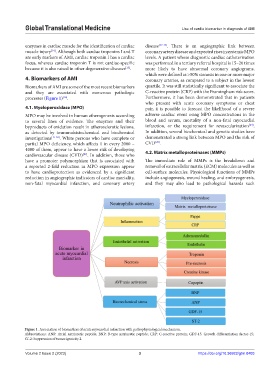
            processes (Figure 1) .                             Furthermore, it has been demonstrated that in patients
                            [16]
                                                               who present with acute coronary symptoms or chest
            4.1. Myeloperoxidase (MPO)                         pair, it is possible to forecast the likelihood of a severe
            MPO may be involved in human atherogenesis according   adverse cardiac event using MPO concentrations in the
            to  several lines  of  evidence. The  enzymes  and their   blood and serum, mortality of a non-fatal myocardial
                                                                                                           [24]
            byproducts of oxidation result in atherosclerotic lesions,   infarction, or the requirement for revascularization .
            as detected by immunohistochemical and biochemical   In addition, several biochemical and genetic studies have
            investigations [17-20] . White persons who have complete or   demonstrated a strong link between MPO and the risk of
                                                                   [25]
            partial MPO deficiency, which affects 1 in every 2000 –   CVD .
            4000 of them, appear to have a lower risk of developing   4.2. Matrix metalloproteinases (MMPs)
            cardiovascular disease (CVD) . In addition, those who
                                    [21]
            have a promoter polymorphism that is associated with   The  immediate role  of  MMPs  is  the  breakdown  and
            a  reported  2-fold  reduction  in  MPO  expression  appear   removal of extracellular matrix (ECM) molecules as well as
            to have cardioprotection as evidenced by a significant   cell-surface molecules. Physiological functions of MMPs
            reduction in angiographic indicators of cardiac mortality,   include angiogenesis, wound healing, and embryogenesis,
            non-fatal myocardial infarction, and coronary artery   and they may also lead to pathological hazards such


            Figure 1. Association of biomarkers of acute myocardial infarction with pathophysiological mechanism.
            Abbreviations: ANP: Atrial natriuretic peptide; BNP: B-type natriuretic peptide; CRP: C-reactive protein; GDF-15: Growth differentiation factor-15;
            ST-2: Suppression of tumorigenicity 2.


            Volume 2 Issue 2 (2023)                         3                        https://doi.org/10.36922/gtm.0403

