


Page 102 - GTM-3-3
P. 102
Global Translational Medicine                                  Rheumatoid nodule versus fibrocaseous tubercle


            located 1.5 – 2 cm apart and a third similar hazelnut-sized   light-green-orcein   and collagen-specific  picrosirius
                                                                             4
            lesion. The surrounding lung tissue exhibited a prominent   red F3BA staining  (Figure  7). Immunohistochemical
                                                                               5,6
            alveolar pattern. Microscopically, an eosinophilic necrotic   analysis revealed that CD3  T-lymphocytes dominated
                                                                                      +
            area was identified, surrounded by a demarcation zone   the inflammatory infiltrate, along with CD20  B-cells and
                                                                                                   +
            of histiocytes and multinucleated macrophages. Residual   CD68  histiocytes (Figure  8). Acid-fast bacilli were not
                                                                    +
            blood vessel structures were present within the necrotic   detected using Ziehl-Neelsen staining.  However, based on
                                                                                             3
            area, confirmed by elastic fiber staining. A  medium-  the characteristic histology, the lesion was diagnosed as a
            sized blood vessel located near the lesion was found   RhNod, accompanied by systemic rheumatoid vasculitis,
            to have its lumen filled with granulation tissue. The   interstitial pneumonitis, and pleuritis. The seropositive
            interstitial alveolar septa were widened. Ziehl-Neelsen   RA was well controlled with steroid therapy (Medrol).
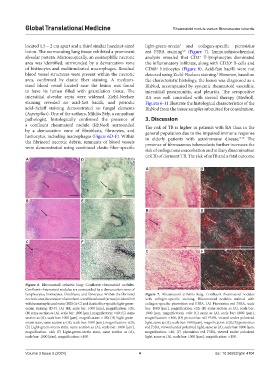
            staining revealed no acid-fast bacilli, and periodic   Figures 6-11 illustrate the histological characteristics of the
            acid–Schiff  staining  demonstrated  no  fungal  elements   RhNod from the tissue samples submitted for consultation.
            (Aspergillus). One of the authors, Miklós Bély, a consultant
            pathologist,  histologically  confirmed  the  presence  of   3. Discussion
            a confluent rheumatoid nodule (RhNod) surrounded   The risk of TB is higher in patients with RA than in the
            by a demarcation zone of fibroblasts, fibrocytes, and   general population due to the impaired immune response
            histiocytes, including macrophages (Figure 6D-F). Within   in  elderly  patients  with  autoimmune  disease. 7-12   The
            the fibrinoid necrotic debris, remnants of blood vessels   presence of fibrocaseous tuberculosis further increases the
            were demonstrated using combined elastic fiber-specific
                                                               risk of endogenous exacerbation and miliary dissemination
                                                               (mTB) of dormant TB. The risk of mTB and a fatal outcome
            A                       D
                                                               A                      D


            B                       E
                                                               B                       E


            C                       F
                                                               C                       F


            Figure  6. Rheumatoid arthritis lung: Confluent rheumatoid nodules.
            Confluent rheumatoid nodules are surrounded by a demarcation zone of
            lymphocytes, histiocytes, fibroblasts, and fibrocytes. Within the fibrinoid   Figure  7. Rheumatoid arthritis lung: Confluent rheumatoid nodules
            necrotic area, the contour of a medium-sized blood vessel (arrows) is identified   with collagen-specific staining. Rheumatoid nodules stained with
            with hematoxylin and eosin (HE) (A-C) and elastic fiber-specific light-green-  collagen-specific picrosirius red F3BA. (A) Picrosirius red F3BA, scale
            orcein staining (D-F). (A) HE, scale bar: 1000 [µm], magnification: ×20;   bar: 1000 [µm], magnification: ×20; (B) same section as (A), scale bar:
            (B) same section as (A), scale bar: 1000 [µm], magnification: ×40; (C) same   1000 [µm, magnification: ×40; (C) same as (A), scale bar: 1000 [µm],
            section as (A), scale bar: 1000 [µm], magnification: ×100; (D) Light-green-  magnification: ×100; (D) picrosirius red F3BA, viewed under polarized
            orcein stain, same section as (A), scale bar: 1000 [µm], magnification: ×20;   light, same as (A), scale bar: 1000 [µm], magnification: ×20; (E) picrosirius
            (E) Light-green-orcein stain, same section as (A), scale bar: 1000 [µm],   red F3BA, viewed under polarized light, same as (A), scale bar: 1000 [µm,
            magnification: ×40; (F) Light-green-orcein stain, same section as (A),   magnification: ×40; (F) picrosirius red F3BA, viewed under polarized
            scale bar: 1000 [µm], magnification: ×100.         light, same as (A), scale bar: 1000 [µm], magnification: ×100.


            Volume 3 Issue 3 (2024)                         4                               doi: 10.36922/gtm.4104

