


Page 100 - GTM-3-3
P. 100
Global Translational Medicine                                  Rheumatoid nodule versus fibrocaseous tubercle


            clinical histories of two RA patients. The findings are based   A         B
            on a unique autopsy population and biopsy material from
            the Department of Pathology, as well as material received
            in consultation over nearly 50 years.
            2. Case presentation

            2.1. Case 1
            A 56-year-old female patient with a long-standing history   C             D
            of seropositive RA was being managed effectively with
            leflunomide (Sanofi-Aventis, Deutschland), remaining
            largely asymptomatic. During a routine lung screening, a
            bifocal lung lesion was detected. Chest X-ray and computed
            tomography scan, performed at the Pulmonology Clinic
            of Semmelweis University, revealed a 15 × 18 mm well-
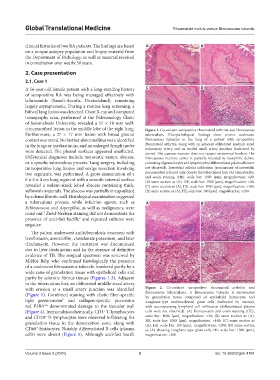
            circumscribed lesion in the middle lobe of the right lung.   Figure 1. Co-existent seropositive rheumatoid arthritis and fibrocaseous
            Furthermore, a 27 × 17  mm lesion with broad pleural   tuberculosis. Histopathological findings show erosive coalescent
            contact was noted. No further abnormalities were identified   fibrocaseous tubercles in  the lung of a patient with seropositive
            in the lungs or mediastinum, and no enlarged lymph nodes   rheumatoid arthritis, along with an adjacent obliterated medium-sized
            were detected. The pleural surfaces appeared unaffected.   pulmonary artery and an eroded small artery junction (indicated by
                                                               arrow). The caseous necrosis does not respect anatomical borders. The
            Differential  diagnoses  include  metastatic  tumor,  abscess,   fibrocaseous necrotic center is partially boarded by basophilic debris,
            or a specific tuberculous process. Lung surgery, including   consisting of granulocytes and lymphocytes (differentiated plasm cells were
            intraoperative lung biopsy and wedge resection involving   not observed). Interstitial cellular infiltration (reminiscent of interstitial
            two segments, was performed. A gross examination of a   pneumonitis) is found only close to the tuberculous foci. (A) Hematoxylin
            6 × 6 × 4 cm lung segment with a smooth external surface   and eosin staining (HE), scale bar: 1000 [µm], magnification: ×20;
                                                               (B) same section as (A), HE, scale bar: 1000 [µm], magnification: ×40;
            revealed a walnut-sized, lobed abscess containing thick,   (C) same section as (A), HE, scale bar: 1000 [µm], magnification: ×100;
            yellowish materials. The abscess was partially encapsulated   (D) same section as (A), HE, scale bar: 100 [µm], magnification: ×200.
            by a dense fibrotic wall. Histological examination suggested
            a tuberculous process, while infection agents, such as   A                B
            Echinococcus and Aspergillus, as well as malignancy, were
            ruled out.  Ziehl-Neelsen staining did not demonstrate the
                    2
            presence of acid-fast bacilli,  and repeated cultures were
                                   3
            negative.
              The patient underwent antituberculosis treatment with
            levofloxacin, amoxicillin, clavulanate potassium, and later
            clindamycin. However, the treatment was discontinued   C                  D
            due to liver dysfunction and in the absence of definitive
            evidence  of  TB.  The  surgical  specimen  was  reviewed  by
            Miklós Bély, who confirmed histologically the presence
            of a coalescent fibrocaseous tubercle, bordered partly by a
            wide zone of granulation tissue with epithelioid cells and
            partly by sclerotic fibrous tissues (Figures 1-3). Adjacent
            to the tuberculous foci, an obliterated middle-sized artery
            with erosion at a small artery junction was identified   Figure  2. Co-existent seropositive rheumatoid arthritis and
            (Figure  1). Combined staining with elastic fiber-specific   fibrocaseous tuberculosis. A  fibrocaseous tubercle is surrounded
                                                               by  granulation  tissue  composed  of  epithelioid  histiocytes  and
            light green-orcein  and collagen-specific picrosirius   Langhans-type multinucleated giant cells (indicated by arrows),
                           4
            red  F3BA   demonstrated  damage  to  the  vascular  wall   with accompanying lymphoid cell infiltration (differentiated plasma
                    5,6
            (Figure 4). Immunohistochemically, CD3  T-lymphocytes   cells  were not observed). (A)  Hematoxylin and eosin staining (HE),
                                             +
            and CD20  B-lymphocytes were observed infiltrating the   scale bar: 1000  [µm], magnification: ×40; (B) same section as (A),
                    +
            granulation tissue in the demarcation zone, along with   HE, scale bar: 1000  [µm], magnification: ×100; (C) same section as
                                                               (A), HE, scale bar: 100 [µm],  magnification: ×200; (D) same section
            CD68  histiocytes. Notably, differentiated B-cells (plasma   as (A) showing Langhans-type giant cells, HE, scale bar: 1000 [µm],
                 +
            cells) were absent (Figure  5). Although acid-fast bacilli   magnification: ×200.
            Volume 3 Issue 3 (2024)                         2                               doi: 10.36922/gtm.4104

