


Page 89 - GTM-3-3
P. 89
Global Translational Medicine                                            rh-PDGF for peri-intrabony defects


                         A                                B               C


                         D                             E                       F


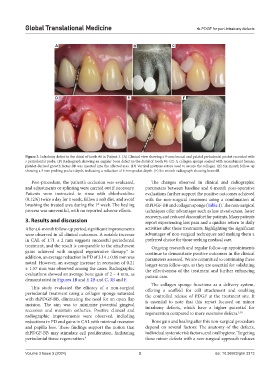
            Figure 3. Infrabony defect in the distal of tooth #6 in Patient 3. (A) Clinical view showing a 9-mm buccal and palatal periodontal pocket recorded with
            a periodontal probe. (B) Radiograph showing an angular bone defect in the distal of tooth #6. (C) A collagen sponge soaked with recombinant human
            platelet-derived growth factor-BB was inserted into the affected area. (D) Vertical mattress suture used to secure the collagen. (E) Six-month follow-up
            showing a 3 mm probing pocket depth, indicating a reduction of 6 mm pocket depth. (F) Six-month radiograph showing bone fill.

              Post-procedure, the patient’s occlusion was evaluated,   The  changes  observed  in clinical and  radiographic
            and adjustments or splinting were carried out if necessary.   parameters between baseline and 6-month post-operative
            Patients were instructed to rinse with chlorhexidine   evaluations further support the positive outcomes achieved
            (0.12%) twice a day for 1 week, follow a soft diet, and avoid   with the non-surgical treatment using a combination of
                                          st
            brushing the treated area during the 1  week. The healing   rhPDGF-BB and collagen sponge (Table 1). The non-surgical
            process was uneventful, with no reported adverse effects.  techniques offer advantages such as less invasiveness, faster
                                                               recovery, and reduced discomfort for patients. Many patients
            3. Results and discussion                          report experiencing less pain and a quicker return to daily
            After a 6-month follow-up period, significant improvements   activities after these treatments, highlighting the significant
            were observed in all clinical outcomes. A notable increase   advantages of non-surgical techniques and making them a
            in  CAL  of  1.71  ±  2  mm  suggests  successful  periodontal   preferred choice for those seeking medical care.
            treatment, and the result is comparable to the attachment   Ongoing research and regular follow-up appointments
            gains achieved with surgical regenerative therapy.  In   continue to demonstrate positive outcomes in the clinical
                                                       9
            addition, an average reduction in PD of 3.14 ± 0.86 mm was   parameters assessed. We are committed to continuing these
            noted. However, an average increase in recession of 0.21   longer-term follow-ups, as they are essential for validating
            ± 1.57 mm was observed among the cases. Radiographic   the effectiveness of the treatment and further enhancing
            evaluations showed an average bone gain of 2 – 4 mm, as   patient care.
            demonstrated in Figures 1B and F, 2B and C, 3B and F.
                                                                 The collagen sponge functions as a delivery system,
              This study evaluated the efficacy of a non-surgical   offering a scaffold for cell attachment and enabling
            periodontal treatment using a collagen sponge saturated   the  controlled  release  of  PDGF  at  the  treatment  site.  It
            with rhPDGF-BB, eliminating the need for an open flap   is essential to note that this report focused on minor
            incision.  The  aim  was  to  minimize  potential  gingival   intrabony defects, which have a higher potential for
            recession and maintain esthetics. Positive clinical and   regeneration compared to more extensive defects. 1,10
            radiographic improvements were  observed,  including
            reductions in PD and gains in CAL with minimal recession   Bone gain and healing after this non-surgical procedure
            and papilla loss. These findings support the notion that   depend on several factors: The anatomy of the defects,
            rhPDGF-BB may stimulate cell proliferation, facilitating   individual systemic risk factors, and oral hygiene. Targeting
            periodontal tissue regeneration. 9                 these minor defects with a non-surgical approach reduces


            Volume 3 Issue 3 (2024)                         3                               doi: 10.36922/gtm.3313

