


Page 88 - GTM-3-3
P. 88
Global Translational Medicine                                            rh-PDGF for peri-intrabony defects


              This study presents 14 consecutively treated cases   options with the patients, and written informed consent
            to  assess  the  efficacy  of  non-surgical  management  for   was obtained.
            intrabony defects in the anterior esthetic area, employing   Clinical parameters such as PD, gingival recession
            a  combination  of  rhPDGF-BB  and  a  collagen  sponge.   depth, and radiographic bone fill were recorded before and
            This minimally invasive approach is designed to achieve   6 months after the surgical intervention (Figures 1-3).
            periodontal repair without compromising esthetic
            outcomes.                                            Patients  received oral  hygiene  instructions,  with an
                                                               emphasis  on  maintaining  oral  health  post-non-surgical
            2. Methods                                         periodontal therapy.  They were also provided with
                                                                                7,8
            Fourteen systemically healthy, non-smoker, non-diabetic   guidance and motivation for effective home care to ensure
            subjects with no history of chemotherapy or radiotherapy   proper oral hygiene.
            were included in this study, conducted at a private practice   The treatment began with local anesthesia using 2%
            in California, United States of America (USA). These   lidocaine and 1:100,000 epinephrine. Ultrasonic scaling,
            individuals presented with single intrabony defects in the   combined with Gracey curettes, was performed to carefully
            anterior  region  of  the maxilla,  and all treatments  were   target the depth of the bony defect, inducing bone scoring
            standardized using the same protocol. Before initiating   and promoting bleeding. Subsequently, a collagen sponge
            treatment, the surgeon thoroughly discussed all treatment   soaked with rh-PDGF-BB (GEM21S, Geistlich North
                                                               America, USA) was then placed in the intrabony pocket
            A                      B                           and packed as apically as possible. The collagen sponge was
                                                               secured with a vertical mattress suture.

                                                               A                             B


            C                      D


                                                               C                        D


                                                               E                            F
            E                       F


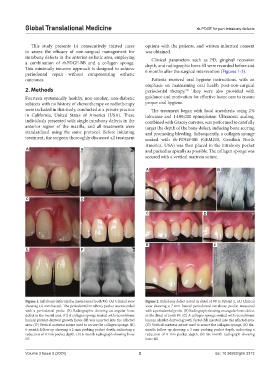
            Figure 1. Infrabony defect in the mesial area (tooth #9). (A) Clinical view   Figure 2. Infrabony defect noted in distal of #9 in Patient 2. (A) Clinical
            showing a 6-mm buccal.  The periodontal intrabony pocket was recorded   view showing a 7-mm buccal periodontal intrabony pocket measured
            with a periodontal probe. (B) Radiographic showing an angular bone   with a periodontal probe. (B) Radiograph showing an angular bone defect
            defect in the mesial area. (C) A collagen sponge soaked with recombinant   in the distal of tooth #9. (C) A collagen sponge soaked with recombinant
            human platelet-derived growth factor-BB was inserted into the affected   human platelet-derived growth factor-BB inserted into the affected area.
            area. (D) Vertical mattress suture used to secure the collagen sponge. (E)   (D) Vertical mattress suture used to secure the collagen sponge. (E) Six-
            6-month follow-up showing a 2 mm probing pocket depth, indicating a   month follow-up showing a 3 mm probing pocket depth, indicating a
            reduction of 4 mm pocket depth. (F) 6-month radiograph showing bone   reduction  of  4  mm  pocket  depth.  (F)  Six-month  radiograph  showing
            fill.                                              bone fill.


            Volume 3 Issue 3 (2024)                         2                               doi: 10.36922/gtm.3313

