


Page 14 - IJAMD-1-1
P. 14
International Journal of AI
            for Material and Design                                               ML in 3D bioprinting of cultivated meat


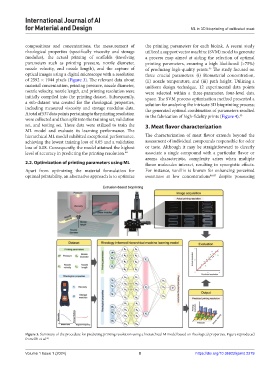
            compositions and concentrations, the measurement of   the printing parameters for each bioink. A  recent study
            rheological properties (specifically viscosity and storage   utilized a support vector machine (SVM) model to generate
            modulus), the actual printing of scaffolds (involving   a process map aimed at aiding the selection of optimal
            parameters such as printing pressure, nozzle diameter,   printing parameters, ensuring a high likelihood (>75%)
            nozzle velocity, and nozzle length), and the capture of   of producing high-quality prints.  The study focused on
                                                                                          45
            optical images using a digital microscope with a resolution   three crucial parameters: (i) Biomaterial concentration,
            of 2592 × 1944 pixels (Figure 3). The relevant data about   (ii) nozzle temperature, and (iii) path height. Utilizing a
            material concentration, printing pressure, nozzle diameter,   uniform design technique, 12 experimental data points
            nozzle velocity, nozzle length, and printing resolution were   were selected within a three-parameter, four-level data
            initially compiled into the printing dataset. Subsequently,   space. The SVM process optimization method presented a
            a  sub-dataset  was  created  for  the  rheological  properties,   solution for analyzing the intricate 3D bioprinting process;
            including measured viscosity and storage modulus data.   the generated optimal combination of parameters resulted
            A total of 537 data points pertaining to the printing resolution   in the fabrication of high-fidelity prints (Figure 4). 45
            were collected and then split into the training set, validation
            set, and testing set. These data were utilized to train the   3. Meat flavor characterization
            ML model and evaluate its learning performance. The
            hierarchical ML model exhibited exceptional performance,   The characterization of meat flavor extends beyond the
            achieving the lowest training loss of 0.05 and a validation   assessment of individual compounds responsible for odor
            loss of 0.08. Consequently, the model attained the highest   or taste. Although it may be straightforward to directly
            level of accuracy in predicting the printing resolution. 44  associate a single compound with a particular flavor or
                                                               aroma  characteristic,  complexity  arises  when  multiple
            2.2. Optimization of printing parameters using ML  flavor molecules interact, resulting in synergistic effects.
            Apart from optimizing the material formulation for   For instance, vanillin is known for enhancing perceived
            optimal printability, an alternative approach is to optimize   sweetness at low concentrations 46,47  despite possessing


            Figure 3. Summary of the procedure for predicting printing resolution using a hierarchical M model based on rheological properties. Figure reproduced
            from Oh et al. .
                     44

            Volume 1 Issue 1 (2024)                         8                       https://doi.org/10.36922/ijamd.2279

