


Page 16 - IJAMD-1-1
P. 16
International Journal of AI
            for Material and Design                                               ML in 3D bioprinting of cultivated meat


            gas chromatography-mass spectroscopy (GC-MS), using   Another study evaluated the use of an artificial neural
            gas chromatography-olfactometry (GC-O)  to  acquire   network  (ANN)  to  predict  the resultant  flavor of  beef
            more detailed sensory characteristics of each compound   tallow after undergoing hydrolysis and Maillard reaction,
            and screen out non-odor-active compounds and finally,   comparing a single input single output (SISO) model that
            building partial least squares regression (PLSR) models to   only considers the relationship between flavor compounds
            correlate the data to that acquired from a sensory panel. 57-59    and sensory scores, and a multiple input single output
            The first two principal components (PCs) often account for   (MISO) model that included the interactions and masking
            a significant portion of the variance in sensory evaluation   effects between flavor compounds.  The models took
                                                                                            60
            attributed to molecular composition. However, individual   the concentration of each of the 47 volatile compounds
            compounds tend to contribute only modestly to sensory   identified through GC × GC-MS as the input, feeding into
            perception.  The application  of  ML in  these  studies  was,   an input layer with a rectified linear unit (ReLU) activation
            hence, useful for their ability to identify the cumulative   function. The models included a multiple-model layer
            effect of many small changes in composition on the overall   with two regimes to limit the output to a maximum and
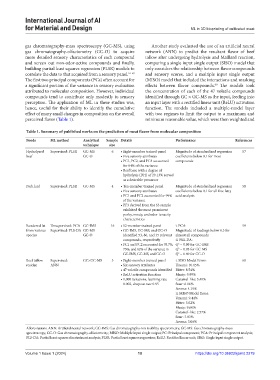
            perceived flavor (Table 1).                        minimum reasonable value, which were then weighted and

            Table 1. Summary of published works on the prediction of meat flavor from molecular composition
            Foods      ML method    Analytical   Sample  Details            Performance              References
                                    technique  size
            Hydrolyzed   Supervised: PLSR  GC-MS  6  • Eight‑member trained panel  Magnitude of standardized regression   57
            beef                    GC-O            • Five sensory attributes  coefficients below 0.1 for most
                                                    •  PC1, PC2, and PC3 accounted   compounds
                                                     for 84% of the variance
                                                    •  Beef base with a degree of
                                                     hydrolysis (DH) of 29.13% served
                                                     as a desirable precursor
            Pork lard  Supervised: PLSR  GC-MS   4  • Ten‑member trained panel  Magnitude of standardized regression   58
                                                    • Five sensory attributes  coefficients below 0.1 for all free fatty
                                                    •  PC1 and PC2 accounted for 99%  acid analysis
                                                     of the variance
                                                    •  PF3 derived from the S3 sample
                                                     exhibited the most prominent
                                                     porky, meaty, and odor-tenacity
                                                     characteristics
            Rendered fat   Unsupervised: PCA GC-IMS  16  • 12‑member trained panel  i. PCA:             59
            from various   Supervised: PLS-DA GC-MS  •  GC‑IMS, GC‑MS, and GC‑O   Magnitude of loadings below 0.3 for
            species                 GC-O             identified 53, 86, and 35 relevant  almost all compounds
                                                     compounds, respectively  ii. PLS-DA:
                                                    •  PC1 and PC2 accounted for 79.7%,  Q  = 0.99 for GC-IMS
                                                                             2
                                                     75%, and 62% of the variance in   Q  = 0.95 for GC-MS
                                                                             2
                                                     GC-IMS, GC-MS, and GC-O   Q  = 0.89 for GC-O
                                                                             2
            Beef tallow   Supervised:  GC×GC-MS  5  • Eight‑member trained panel  i. SISO Model Error:  60
            residue    ANN                          • Six sensory attributes  Umami: 10.15%
                                                    • 47 volatile compounds identified Bitter: 8.54%
                                                    • ReLU activation function  Meaty: 9.89%
                                                    •  1,000 iterations, learning rate   Caramel-like: 3.49%
                                                     0.002, dropout rate 0.95  Sour: 6.06%
                                                                            Aroma: 4.19%
                                                                            ii. MISO Model Error:
                                                                            Umami: 9.44%
                                                                            Bitter: 5.02%
                                                                            Meaty: 9.60%
                                                                            Caramel-like: 2.57%
                                                                            Sour: 7.83%
                                                                            Aroma: 3.06%
            Abbreviations: ANN: Artificial neural network; GC-IMS: Gas chromatography-ion mobility spectrometry; GC-MS: Gas chromatography-mass
            spectroscopy; GC-O: Gas chromatography-olfactometry; MISO: Multiple input single output; PC: Principal component; PCA: Principal component analysis;
            PLS-DA: Partial least squares discriminant analysis; PLSR: Partial least squares regression; ReLU: Rectified linear unit; SISO: Single input single output.


            Volume 1 Issue 1 (2024)                         10                      https://doi.org/10.36922/ijamd.2279

