


Page 21 - IJAMD-1-1
P. 21
International Journal of AI
            for Material and Design                                               ML in 3D bioprinting of cultivated meat


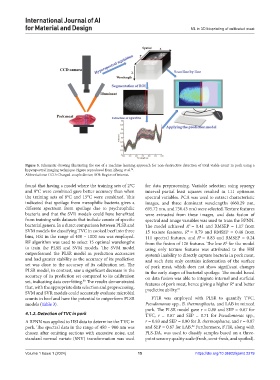
            Figure 5. Schematic drawing illustrating the use of a machine learning approach for non-destructive detection of total viable count in pork using a
                                                         74
            hyperspectral imaging technique. Figure reproduced from Zheng et al. .
            Abbreviations: CCD: Charged-couple device; ROI: Region of interest.
            found that having a model where the training sets of 2°C   for data preprocessing. Variable selection using synergy
            and 8°C were combined gave better accuracy than when   interval partial least squares resulted in 111  optimum
            the training sets of 8°C and 15°C were combined. This   spectral variables. PCA was used to extract characteristic
            indicated  that  spoilage  from  mesophilic  bacteria  gives  a   images, and three dominant wavelengths (660.29  nm,
            different spectrum from spoilage due to psychrophilic   695.72 nm, and 730.43 nm) were selected. Texture features
            bacteria and that the SVR models could have benefitted   were extracted from these images, and data fusion of
            from training with datasets that include counts of specific   spectral and image variables was used to train the BPNN.
            bacterial genera. In a direct comparison between PLSR and   The model achieved  R = 0.41 and RMSEP = 1.17 from
                                                                                 2
            SVM models for classifying TVC in cooked beef into three   15  texture features,  R = 0.79 and RMSEP = 0.46 from
                                                                                 2
            bins, HSI in the range of 400 – 1000 nm was employed.   111  spectral features, and  R = 0.83 and RMSEP = 0.24
                                                                                      2
            RF algorithm was used to select 15 optimal wavelengths   from the fusion of 126 features. The low R  for the model
                                                                                                 2
            to train the PLSR and SVM models. The SVM model    using only texture features was attributed to the HSI
            outperformed the PLSR model in prediction accuracies   system’s inability to directly capture bacteria in pork meat,
            and had greater stability as the accuracy of its prediction   and such data only contains information of the surface
            set was close to the accuracy of its calibration set. The   of pork meat, which does not show significant changes
            PLSR model, in contrast, saw a significant decrease in the   in the early stages of bacterial spoilage. The model based
            accuracy of its prediction set compared to its calibration   on data fusion was able to integrate internal and surficial
            set, indicating data overfitting.  The results demonstrated   features of pork meat, hence giving a higher R  and better
                                    80
                                                                                                    2
            that, with the appropriate data selection and preprocessing,   predictive ability. 81
            SVM and SVR models could accurately evaluate microbial
            counts in beef and have the potential to outperform PLSR   FTIR was employed with PLSR to quantify TVC,
            models (Table 3).                                  Pseudomonas spp., B. thermosphacta, and LAB in minced
                                                               pork. The PLSR model gave r = 0.88 and SEP = 0.67 for
            4.1.2. Detection of TVC in pork                    TVC,  r = 0.87 and SEP = 0.71 for  Pseudomonas spp.,

            A BPNN was applied to HSI data to determine the TVC in   r = 0.83 and SEP = 0.80 for B. thermosphacta, and r = 0.87
            pork. The spectral data in the range of 450 – 900 nm was   and SEP = 0.67 for LAB.  Furthermore, FTIR, along with
                                                                                   82
            chosen  after  omitting  sections  with  excessive  noise,  and   PLS-DA, was used to classify samples based on a three-
            standard normal variate (SNV) transformation was used   point sensory quality scale (fresh, semi-fresh, and spoiled).


            Volume 1 Issue 1 (2024)                         15                      https://doi.org/10.36922/ijamd.2279

