


Page 33 - IJAMD-1-1
P. 33
International Journal of AI
            for Material and Design                                                ML for quality improvement in L-PBF


            material into the desired shape. When a laser beam serves   Machine learning (ML) is a subset of artificial
                                    1,2
            as the heat source for melting the powder, the technique is   intelligence (AI) and can learn from existing data, analyze
            termed laser powder bed fusion (L-PBF) or selective laser   data relationships, and autonomously generate predictions.
            melting (SLM).  The L-PBF production process involves   As a result, the integration of ML into L-PBF offers the
                        3
            the construction of a model using computer-aided design   advantage of bypassing the need for extensive experiments,
            (CAD). The data model is then sliced into two dimensions   thereby saving both time and costs. 15,16  ML leverages
            and imported into the L-PBF equipment.  Next, the   past L-PBF experimental data to train models capable of
                                                4-6
            equipment’s process parameters are configured. During   predicting defects that may occur in the manufactured
            the  fabrication  process,  a high-power laser selectively   parts during the printing process. This capability of
            melts the metal powder layer in a specific area. After   ML  enables real-time  problem  resolution or  prevention
            each layer is melted, the feeding system seamlessly stacks   during actual production.  Simultaneously, the model can
                                                                                   17
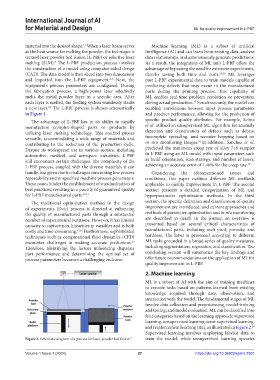
            a new layer.  The L-PBF process is shown schematically   establish correlations between input process parameters
                      7,8
            in Figure 1.                                       and product performance, allowing for the prediction of
              The advantage of L-PBF lies in its ability to rapidly   specific product quality attributes. For example, Scime
            manufacture  complex-shaped  parts  or  products  by   et al. utilized an unsupervised ML algorithm for anomaly
            utilizing laser melting technology. This method proves   detection and classification of defects such as debris,
            versatile, accommodating a wide range of materials and   incomplete spreading, and recoater hopping based on
                                                                                     18

            contributing to the reduction of the production cycle.   in situ monitoring images. In addition, Sanchez  et  al.
            Despite its widespread use in various sectors, including   predicted the minimum creep rate of alloy 718  samples
            automotive,  medical,  and  aerospace  industries,  L-PBF   in L-PBF using an ML model with input parameters such
            still encounters certain challenges. The complexity of the   as build orientation, scan strategy, and number of lasers,
                                                                                                          19
            L-PBF process, coupled with the diverse materials it can   achieving an accurate error of 1.40% for the creep rate.
            handle, has given rise to challenges concerning low process   Considering  the  aforementioned  issues  and
            repeatability and unspecified machine process parameters.   conditions, this paper outlines different ML methods
            These issues hinder the establishment of standardization of   applicable to quality improvement in L-PBF. The second
            best practices, resulting in a paucity of guaranteed quality   section presents a detailed categorization of ML and
            for L-PBF manufactured parts. 10,11                hyperparameter optimization methods. In the third
              The traditional optimization method in the design   section, the specific definition and classification of quality
            of  experiments  (DoE)  process  is  directed  at  enhancing   improvement are introduced, and current approaches and
            the quality of manufactured parts through a substantial   methods of parameter optimization and in situ monitoring
            number of experimental iterations. However, it has limited   are described in detail. In the former, an overview is
            capacity to capture non-linearities in variables and is both   presented based on several critical characteristics of
            costly and time-consuming. 12,13  Furthermore, sophisticated   manufactured parts, including melt pool, porosity, and
            techniques such as computational fluid dynamics (CFD)   hardness. The latter is presented according to different
            encounter challenges in making accurate predictions.    ML tasks grounded in a broad series of quality measures,
                                                         14
            Therefore, identifying the factors influencing disparate   including segmentation, regression, and classification. The
            part performance and determining the optimal set of   concluding section will summarize the key findings and
            process parameters becomes a challenging endeavor.  offer future recommendations on the application of ML for
                                                               quality improvement in L-PBF.

                                                               2. Machine learning
                                                               ML is a subset of AI with the aim of training machines
                                                               to execute tasks based on patterns learned from existing
                                                               knowledge acquired through data, observation, and
                                                               interaction with the world. The fundamental stages of ML
                                                               involve data collection and preprocessing, model training
                                                               and testing, and model evaluation. ML can be classified into
                                                               four categories based on the learning approach: supervised
                                                               learning, unsupervised learning, semi-supervised learning,
                                                               and reinforcement learning (RL), as illustrated in Figure 2.
                                                                                                            20
                                                               Supervised learning involves  employing labeled data  to
            Figure 1. Schematic diagram of a process for laser-powder bed fusion. 9  train the model, while unsupervised learning operates


            Volume 1 Issue 1 (2024)                         27                      https://doi.org/10.36922/ijamd.2301

