


Page 38 - IJAMD-1-1
P. 38
International Journal of AI
            for Material and Design                                                ML for quality improvement in L-PBF


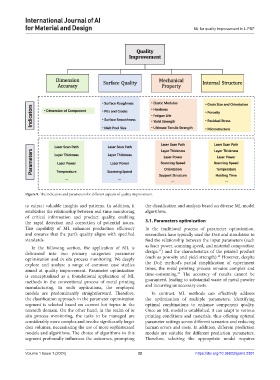
            Figure 9. The indicators and parameters for different aspects of quality improvement.

            to extract valuable insights and patterns. In addition, it   the classification and analysis based on diverse ML model
            establishes the relationship between real-time monitoring   algorithms.
            of critical information and product quality, enabling
            the rapid detection and correction of potential issues.   3.1. Parameters optimization
            This capability of ML enhances production efficiency   In the traditional process of parameter optimization,
            and ensures that the part’s quality aligns with specified   researchers have typically used the DoE and simulation to
            standards.                                         find the relationship between the input parameters (such
              In the following section, the application of ML is   as laser power, scanning speed, and material composition
                                                                     31
            delineated into two primary categories: parameter   design. )  and  the  characteristics of the printed  product
                                                                                              32
            optimization and  in situ process monitoring. We deeply   (such as porosity and yield strength).  However, despite
            explore and analyze a range of common case studies   the DoE method’s partial simplification of experiment
            aimed at quality improvement. Parameter optimization   times, the metal printing process remains complex and
                                                                             33
            is conceptualized as a foundational application of ML   time-consuming.  The accuracy of results cannot be
            methods in the conventional process of metal printing   guaranteed, leading to substantial waste of metal powder
            manufacturing. In such applications, the employed   and incurring unnecessary costs.
            models  are predominantly straightforward.  Therefore,   In contrast, ML methods can effectively address
            the classification approach in the parameter optimization   the optimization of multiple parameters, identifying
            segment is selected based on current hot topics in the   optimal combinations to enhance component quality.
            research domain. On the other hand, in the realm of in   Once an ML model is established, it can adapt to various
            situ  process  monitoring, the  tasks  to  be managed are   printing conditions and materials, thus offering optimal
            considerably more complex and involve significantly larger   parameter settings across different scenarios and reducing
            data volumes, necessitating the use of more sophisticated   human errors and costs. In addition, different prediction
            models and algorithms. The choice of algorithms in this   models are suitable for different prediction parameters.
            segment profoundly influences the outcomes, prompting   Therefore, selecting the appropriate model requires


            Volume 1 Issue 1 (2024)                         32                      https://doi.org/10.36922/ijamd.2301

