


Page 39 - IJAMD-1-1
P. 39
International Journal of AI
            for Material and Design                                                ML for quality improvement in L-PBF


            careful consideration of the specific characteristics and   Akbari et al. introduced a comprehensive framework
            requirements of the data and the prediction task at hand.    for benchmarking ML for melt pool characterization.
                                                                                                            37
                                                         34
            Wang et al. established a correlation between key process   A substantial collection of melt pool characteristics data
            parameters and quality indicators at two levels: the   was acquired from L-PBF experiments and employed for
            mesoscale level and the macroscale level.  Specifically, the   developing the ML model. Various ML models were built
                                            35
            mesoscale level pertains to porosity or relative density, as   to predict melt pool characteristics. Among these models,
            well as melt pool geometries, while the macroscale level   NNs and gradient boosting consistently demonstrated
            refers to mechanical properties. This approach allows for a   superior predictive performance on regression tasks.
            comprehensive understanding of the relationship between   Furthermore, the study emphasized the critical importance
            process parameters and quality indicators, enabling   of selecting appropriate feature engineering techniques to
            informed decision-making and process optimization.  enhance the accuracy of the predictions.

            3.1.1. Melt pool characteristic                      The research conducted by Lee  et al. focuses on the
                                                               application of advanced data analytics for understanding
            The characteristics of the melt pool exert a significant   and predicting the formation of melt pools within a
            impact on the quality of metal 3D-printed products. The   physics-based context.  Their investigation reveals that
                                                                                 38
            shape and geometry of the melt pool can influence the   the dimensions of the melt pool, namely its depth, width,
            microstructure of the material. The utilization of a well-  and height, are closely related to various physical factors.

            defined and stable melt pool yields a more uniform and   Specifically, the depth of the melt pool correlates with laser
            fine-grained microstructure. In addition, the geometric   penetration, the width is tied to fluid convection, and the
            structure of the melt pool plays a critical role in determining   height corresponds to the mechanical properties of the
            the occurrence of defects such as lack of fusion, balling,   melted powders.
            or keyhole porosity. Irregular melt pool shapes are often
                            36
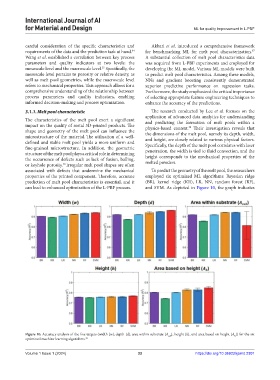
            associated with defects that undermine the mechanical   To predict the geometry of the melt pool, the researchers
            properties of the printed component. Therefore, accurate   employed six  optimized  ML algorithms:  Bayesian ridge
            prediction of melt pool characteristics is essential, and it   (BR),  kernel  ridge  (KR),  LR, NN,  random  forest  (RF),
            can lead to enhanced optimization of the L-PBF process.  and SVM. As depicted in Figure 10, the graph indicates


            Figure 10. Accuracy analysis of the five targets (width [w], depth [d], area within substrate [A ], height [h], and area based on height [A ]) for the six
                                                                                                     h
                                                                         sub
            optimized machine learning algorithms. 38
            Volume 1 Issue 1 (2024)                         33                      https://doi.org/10.36922/ijamd.2301

