


Page 36 - IJAMD-1-1
P. 36
International Journal of AI
            for Material and Design                                                ML for quality improvement in L-PBF


            of the environment, the action of the agent, and the ensuing   is used to train ML models. This process is repeated N times
            reward. The general steps circle is illustrated in Figure 5,   until the best-performing model and its corresponding
            where, at each time step (t), the agent receives a state (st)   hyperparameters are identified for subsequent use in
            within the state space (S) and chooses an action (at) from   actual training and testing.  The illustration of the
                                                                                       26
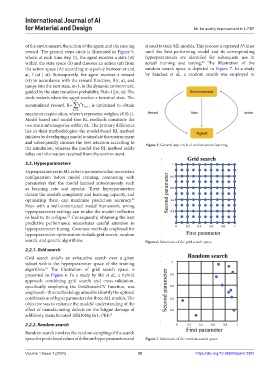
            the action space (A) according to a policy between st and   random search space is depicted in Figure 7. In a study
            at, f (at | st). Subsequently, the agent receives a reward   by Sanchez  et  al., a random search was employed to
            (rt) in accordance with the reward function, R(r, a), and
            jumps into the next state, st+1, in the dynamic environment,
            guided by the state transition probability, P(st+1 | st, at). The
            circle restarts when the agent reaches a terminal state. The
                                 ∞
            accumulated reward, R= ∑ γ k r + t k , is optimized to obtain
                                k0
                                 =
            maximum expectation, where γ represents weights, γ∈(0,1).
            Model-based and model-free RL methods constitute the
            two main subcategories within RL. The primary difference
            lies in their methodologies: the model-based RL method
            initiates by developing a model to simulate the environment
            and subsequently chooses the best situation according to   Figure 5. General step circle of reinforcement learning.
            the simulation, whereas the model-free RL method solely
            relies on information received from the environment.

            2.2. Hyperparameters
            Hyperparameters in ML refer to parameters that necessitate
            configuration before model training, contrasting with
            parameters that the model learned autonomously, such
            as learning rate and epochs. These hyperparameters
            dictate the model’s complexity and learning capacity, and
            optimizing them can maximize prediction accuracy. 22
            Even with a  well-constructed  model  framework,  wrong
            hyperparameter settings can render the model ineffective
            or lead to its collapse.  Consequently, obtaining the best
                              23
            predictive  performance  necessitates  careful  attention  to
            hyperparameter tuning. Common methods employed for
            hyperparameter optimization include grid search, random
            search, and genetic algorithms.                    Figure 6. Schematic of the grid search space.

            2.2.1. Grid search
            Grid search entails an exhaustive search over a given
            subset within the hyperparameter space of the training
            algorithm.  The illustration of grid search space is
                    24
            presented in  Figure  6. In a study by Shi  et al., a hybrid
            approach combining grid search and cross-validation,
            specifically employing the GridSearchCV function, was
            employed – this methodology aimed to identify the optimal
            combination of hyperparameters for three ML models. The
            objective was to enhance the models’ understanding of the
            effect of manufacturing defects on the fatigue damage of
            additively manufactured AlSi10Mg in L-PBF. 25

            2.2.2. Random search
            Random search involves the random sampling of the search
            space for predefined values of different hyperparameters and   Figure 7. Schematic of the random search space.


            Volume 1 Issue 1 (2024)                         30                      https://doi.org/10.36922/ijamd.2301

