


Page 37 - IJAMD-1-1
P. 37
International Journal of AI
            for Material and Design                                                ML for quality improvement in L-PBF


            optimize hyperparameters for four ML models separately.
            This approach proved effective in enhancing the models’
            predictive capabilities for determining the minimum creep
            rate of alloy 718 samples in L-PBF. 18
            2.2.3. Genetic algorithm
            A genetic algorithm is an evolutionary search algorithm
            that mimics the process of natural selection, wherein the
            algorithm’s data structure resembles a chromosome. The
            process of the genetic algorithm begins with a randomly
            generated population of chromosomes, followed by
            population evaluation. If an optimal solution is identified,
            the process concludes; otherwise, the algorithm undergoes
            selection, crossover, and mutation operations to obtain a
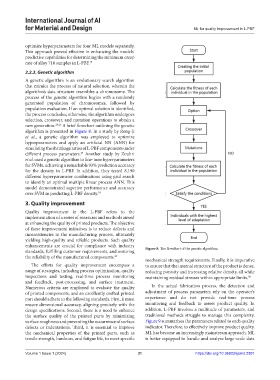
            new generation. 23,26  A brief flowchart outlining the genetic
            algorithm is presented in Figure 8. In a study by Rong-Ji
            et al., a genetic algorithm was employed to optimize
            hyperparameters and apply an artificial NN (ANN) for
            simulating the shrinkage ratios of L-PBF components under
            different process parameters.  Another study by Zouhri
                                   27
            et al. used a genetic algorithm to fine-tune hyperparameters
            for SVMs, achieving a remarkable 93% prediction accuracy
            for the density in L-PBF. In addition, they tested 8,190
            different hyperparameter combinations using grid search
            to identify an optimal multiple linear process ANN. This
            model demonstrated superior performance and accuracy
            over SVM in predicting L-PBF density. 28

            3. Quality improvement
            Quality improvement in the L-PBF refers to the
            implementation of a series of measures and methods aimed
            at enhancing the quality of printed products. The objective
            of these improvement initiatives is to reduce defects and
            inconsistencies in the manufacturing process, ultimately
            yielding high-quality and reliable products. Such quality
            enhancements are crucial for compliance with industry
            standards, fulfilling customer requirements, and ensuring   Figure 8. The flowchart of the genetic algorithm.
            the reliability of the manufactured components. 29
                                                               mechanical strength requirements. Finally, it is imperative
              The efforts for quality improvement encompass a   to ensure that the internal structure of the product is dense,
            range of strategies, including process optimization, quality   reducing porosity and increasing relative density, all while
            inspections  and  testing,  real-time  process  monitoring   maintaining residual stresses within appropriate limits. 30
            and feedback, post-processing, and surface treatment.
            Numerous  criteria  are  employed  to  evaluate  the  quality   In the actual fabrication process, the detection and
            of printed components, and an excellently crafted printed   adjustment of process parameters rely on the operator’s
            part should adhere to the following standards. First, it must   experience and do not provide real-time process
            ensure dimensional accuracy, aligning precisely with the   monitoring and feedback to assess product quality. In
            design specifications. Second, there is a need to enhance   addition, L-PBF involves a multitude of parameters, and
            the surface quality of the printed parts by minimizing   traditional methods struggle to manage this complexity.
            surface roughness and preventing the occurrence of surface   Figure 9 summarizes the parameters related to each quality
            defects or indentations. Third, it is essential to improve   indicator. Therefore, to effectively improve product quality,
            the mechanical properties of the printed parts, such as   ML has become an increasingly mainstream approach. ML
            tensile strength, hardness, and fatigue life, to meet specific   is better equipped to handle and analyze large-scale data


            Volume 1 Issue 1 (2024)                         31                      https://doi.org/10.36922/ijamd.2301

