


Page 34 - IJAMD-1-1
P. 34
International Journal of AI
            for Material and Design                                                ML for quality improvement in L-PBF


            without  utilizing  labeled  data.  Semi-supervised  learning   wherein  the  acquisition  of  new  knowledge  from  prior
            combines supervised learning and unsupervised learning,   experiences facilitates the subsequent delivery of
            utilizing  a  limited  amount  of  labeled  data  and  a  more   appropriate solutions in new circumstances, leveraging the
            substantial volume of unlabeled data for model training.   learned knowledge or methodology. However, machines
            RL, on the other hand, lacks supervised signals, but it   or models must learn from the provided data due to the
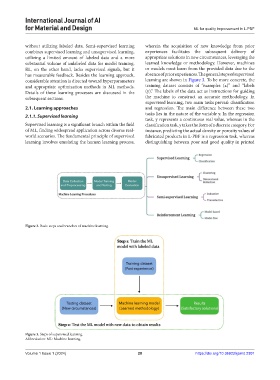
            has measurable feedback. Besides the learning approach,   absence of prior experiences. The general steps of supervised
            considerable attention is directed toward hyperparameters   learning are shown in Figure 3. To be more concrete, the
            and appropriate optimization  methods  in ML  methods.   training dataset consists of “examples (x)” and “labels
            Details of these learning processes are discussed in the   (y).” The labels of the data act as instructions for guiding
            subsequent sections.                               the  machine  to  construct  an  accurate  methodology.  In
                                                               supervised learning, two main tasks prevail: classification
            2.1. Learning approaches                           and  regression.  The  main  difference  between  these  two
            2.1.1. Supervised learning                         tasks lies in the nature of the variable y. In the regression
                                                               task, y represents a continuous real value, whereas in the
            Supervised learning is a significant branch within the field   classification task, y takes the form of a discrete category. For
            of ML, finding widespread application across diverse real-  instance, predicting the actual density or porosity values of
            world scenarios. The fundamental principle of supervised   fabricated products in L-PBF is a regression task, whereas
            learning involves emulating the human learning process,   distinguishing between poor and good quality in printed


            Figure 2. Basic steps and branches of machine learning.


            Figure 3. Steps of supervised learning.
            Abbreviation: ML: Machine learning.


            Volume 1 Issue 1 (2024)                         28                      https://doi.org/10.36922/ijamd.2301

