


Page 35 - IJAMD-1-1
P. 35
International Journal of AI
            for Material and Design                                                ML for quality improvement in L-PBF


            products falls within the domain of a classification task.   most representative features while eliminating irrelevant
            Linear regression (LR) is a prominent regression model in   and  noisy information in the data. While unsupervised
            supervised learning. Numerous ML models demonstrate   learning reduces the labeling workload, it introduces
            proficiency in handling classification tasks, such as neural   challenges in precisely evaluating the model. In addition,
            network (NN), support vector machine (SVM), decision   the outcomes of unsupervised learning methods can be
            tree (DT), and K-nearest neighbor (KNN).           susceptible to the impact of arbitrarily selected initial values.

            2.1.2. Unsupervised learning                       2.1.3. Semi-supervised learning
            In  comparison  to  supervised  learning,  unsupervised   Acquiring large, labeled datasets proves to be both
            learning greatly alleviates the challenges associated   costly and tedious in the context of supervised learning.
            with the time-consuming and labor-intensive labeling   Simultaneously, unsupervised learning heavily relies
            process, as it does not require data labels for model   on initial assumptions and poses challenges in terms of
            training. Unsupervised learning broadly falls into two   evaluation. Semi-supervised learning bridges these gaps by
            main categories: clustering and dimensionality reduction.   utilizing a combined approach that leverages both labeled
            Representation clustering methods include  K-means,   and unlabeled data. In this way, labeled data serves as
            hierarchical clustering (HC), Gaussian mixtures (GM),   restrictions or introductions to the model, while unlabeled
            among others. The input for clustering methods is the   data prevents overfitting and reduces the laborious labeling
            training data, and the output is a set of clusters. The   process. The majority of semi-supervised methods are based
            allocation of data points relies on a similarity assessment,   on  the  smoothness  assumption,  low-density  assumption,
                                                                                    21
            which is crucial for clustering methods. For example, the   and manifold assumption.  The smoothness assumption
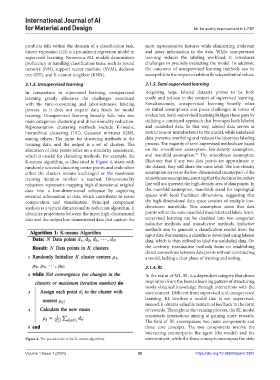
            K-means algorithm, as illustrated in Figure 4, starts with   illustrates that if any two data points are approximate in
            randomly selected clustering center points and ends when   the dataset, they will share the same label. The low-density
            either the clusters remain unchanged or the maximum   assumption serves as the low-dimensional counterpart of the
            training iteration number is reached. Dimensionality   smoothness assumption, asserting that the decision boundary
            reduction represents mapping high-dimensional original   line will not intersect the high-density area of data points. In
            data into a low-dimensional subspace by capturing   the  manifold  assumption,  manifolds  stand for  topological
            essential information in data, which contributes to easier   spaces with local Euclidean dimensions, suggesting that
            computation and visualization. Principal component   the high-dimensional data space consists of multiple low-
            analysis is a typical dimensionality reduction algorithm. It   dimension manifolds. This assumption states that data
            identifies projections between the input high-dimensional   points within the same manifold share identical labels. Semi-
            data and the output low-dimensional data that capture the   supervised learning can be classified into two categories:
                                                               inductive methods and transductive methods. Inductive
                                                               methods aim to generate a classification model from the
                                                               input data. For example, a classifier is developed using labeled
                                                               data, which is then utilized to label the unlabeled data. On
                                                               the contrary, transductive methods focus on establishing
                                                               direct connections between data points without constructing
                                                               a model, lacking a clear phase of training and testing.
                                                               2.1.4. RL
                                                               In the realm of ML, RL is a dependent category that draws
                                                               inspiration from the human learning pattern of structuring
                                                               newly obtained knowledge through interactions with the
                                                               environment. Different from supervised and unsupervised
                                                               learning, RL involves a model that is not supervised;
                                                               instead, it obtains valuable numerical feedback in the form
                                                               of rewards. Throughout the training process, the RL model
                                                               constructs interactions aiming at gaining more rewards.
                                                               The field of RL encompasses two main components and
                                                               three core concepts. The two components involve the
                                                               interacting counterparts: the agent (the model) and the
            Figure 4. The pseudocode of the K-means algorithm.  environment, while the three concepts encompass the state


            Volume 1 Issue 1 (2024)                         29                      https://doi.org/10.36922/ijamd.2301

