


Page 49 - IJAMD-2-1
P. 49
International Journal of AI for
Materials and Design
ML-based MPC for multizone BAC
When the test space is controlled by the existing building The ML model for predicting indoor PMV is developed
management system (referred to as “BMS” in this study), using a NARX feedback neural network, a recurrent
cooling power delivered to the test space is regulated by neural network commonly used for time-series modeling.
controlling the chilled water flow rate through each FCU’s A detailed description of the development of the ML
cooling coil through a motorized water valve using a PID network for MPC is provided in Section 4. For the MPC
controller. The control is based on a temperature setpoint of controller, the cooling power supplied by the FCU cooling
21°C, measured by a thermostat located at the diffuser outlet. coil serves as the manipulated variable and is the control
Each zone is equipped with a set of sensors, including signal to be optimized. The current cooling power is
globe temperature, ambient temperature, and humidity measured as feedback using the BTU meter installed in
sensors for measuring thermal comfort, as well as CO each FCU within the zone. The number of occupants,
2
sensors for measuring occupancy within each zone. For representing the internal heat load, is measured using the
the evaluation of the predicted mean vote (PMV) as per duct CO and flow sensors at the FCU and PAU, along with
2
ASHRAE 55, ambient air velocity, metabolic rate, and the indoor CO sensors in each zone. Outdoor temperature
33
2
clothing insulation factor for each occupant were assumed and solar radiation data are obtained from the rooftop
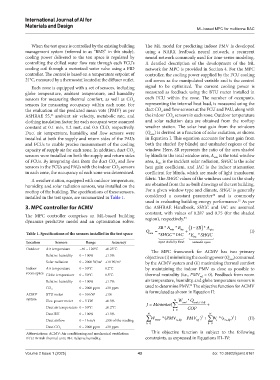
constant at 0.1 m/s, 1.2 met, and 0.5 CLO, respectively. weather station. The solar heat gain from the windows
Duct air temperature, humidity, and flow sensors were (Q ) is derived as a function of solar radiation, as shown
win
installed at both the supply and return sides of the PAUs in Equation I. This equation accounts for heat gain from
and FCUs to enable precise measurement of the cooling both the shaded (by blinds) and unshaded regions of the
capacity of supply air for each zone. In addition, duct CO window. Here, SR represents the ratio of the area shaded
2
sensors were installed on both the supply and return sides by blinds to the total window area, A is the total window
win
of FCUs. By integrating data from the duct CO and flow area, E is the incident solar radiation, SHGC is the solar
2
inc
sensors in the FCUs and PAUs with the indoor CO sensors heat gain coefficient, and IAC is the indoor attenuation
2
in each zone, the occupancy of each zone was determined. coefficient for blinds, which are made of light translucent
A weather station, equipped with outdoor temperature, fabric. The SHGC values of the windows used in the study
humidity, and solar radiation sensors, was installed on the are obtained from the as-built drawings of the test building.
rooftop of the building. The specifications of these sensors, For a given window type and climate, SHGC is generally
34
installed in the test space, are summarized in Table 1. considered a constant parameter and is commonly
used in evaluating building energy performance. As per
35
3. MPC controller for ACMV the ASHRAE Handbook, SHGC and IAC are assumed
constant, with values of 0.287 and 0.75 (for the shaded
The MPC controller comprises an ML-based building region), respectively. 33
dynamics predictive model and an optimization solver.
SR A win * E inc 1 SR * A win
*
Table 1. Specifications of the sensors installed in the test space Q win * SHGC IAC *E * SHGC (I)
*
inc
Location Sensors Range Accuracy region shaded by blinds unshaded region
Outdoor Air temperature −40 – 120°C ±0.25°C The MPC framework for ACMV has two primary
Relative humidity 0 – 100% ±1.5% objectives: (i) minimizing the cooling power (Q ) consumed
cool
Solar radiation 0 – 2000 W/m 2 ±10 W/m 2 by the ACMV system and (ii) maximizing thermal comfort
Indoor Air temperature 0 – 50°C 0.2°C by maintaining the indoor PMV as close as possible to
room space Globe temperature 0 – 50°C 0.5°C thermal neutrality (i.e., PMV = 0). Feedback from room
ref
Relative humidity 0 – 100% ±1.7% air temperature, humidity, and globe temperature sensors is
33
0 – 2000 ppm ±30 ppm used to determine PMV. The objective function for ACMV
CO 2
ACMV BTU meter 0 – 50 kW ±1% is formulated as shown in Equation II:
system Elec. power meter 0 – 5 kW ±0.5% N W cool * Q cool tk t |
,
Duct air temperature 0 – 50°C ±0.2°C J Minimize( COP
k0
Duct RH 0 – 100% ±1.5% N 2 N 2
Duct airflow 0 – 16 m/s ±5% of the reading W PMV *( PMV t kt | PMMV ) W *( tk t| ) ) (II)
ref
k0 k 0
0 – 2000 ppm ±30 ppm
Duct CO 2
Abbreviations: ACMV: Air conditioning and mechanical ventilation; This objective function is subject to the following
BTU: British thermal unit; RH: Relative humidity. constraints, as expressed in Equations III–IV:
Volume 2 Issue 1 (2025) 43 doi: 10.36922/ijamd.8161

