


Page 53 - IJAMD-2-1
P. 53
International Journal of AI for
            Materials and Design
                                                                                     ML-based MPC for multizone BAC


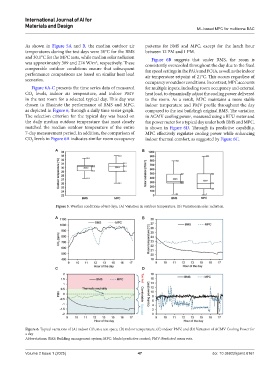
            As shown in  Figure  5A  and  B, the median outdoor air   patterns  for  BMS  and  MPC,  except  for  the  lunch  hour
            temperatures during the test days were 30°C for the BMS   between 12 PM and 1 PM.
            and 30.1°C for the MPC tests, while median solar radiation   Figure  6B suggests that under BMS, the room is
            was approximately 309 and 274 W/m , respectively. These   consistently overcooled throughout the day due to the fixed
                                          2
            comparable  outdoor  conditions  ensure  that  subsequent   fan speed settings in the PAUs and FCUs, as well as the indoor
            performance comparisons are based on similar heat load   air temperature setpoint of 21°C. This occurs regardless of
            scenarios.                                         occupancy or outdoor conditions. In contrast, MPC accounts
              Figure 6A-C presents the time series data of measured   for multiple inputs, including room occupancy and external
            CO  levels, indoor air temperature, and indoor PMV   heat load, to dynamically adjust the cooling power delivered
               2
            in the test room for a selected typical day. This day was   to the room. As a result, MPC maintains a more stable
            chosen to illustrate the performance of BMS and MPC,   indoor temperature and PMV profile throughout the day
            as depicted in Figure 6, through a daily time series graph.   compared to the test building’s original BMS. The variation
            The selection criterion for the typical day was based on   in ACMV cooling power, measured using a BTU meter and
            the daily median outdoor temperature that most closely   fan power meter for a typical day under both BMS and MPC,
            matched the median outdoor temperature of the entire   is shown in  Figure  6D. Through its predictive capability,
            7-day measurement period. In addition, the comparison of   MPC effectively regulates cooling power while enhancing
            CO  levels in Figure 6A indicates similar room occupancy   indoor thermal comfort, as suggested by Figure 6C.
               2
                         A                                   B


                         Figure 5. Weather conditions of test days. (A) Variation in outdoor temperature, (B) Variation in solar radiation.

                         A                                   B


                         C                                   D


            Figure 6. Typical variations of (A) indoor CO 2  in a test space, (B) indoor temperature, (C) indoor PMV, and (D) Variation of ACMV Cooling Power for
            a day
            Abbreviations: BMS: Building management system; MPC: Model predictive control; PMV: Predicted mean vote.


            Volume 2 Issue 1 (2025)                         47                             doi: 10.36922/ijamd.8161

