


Page 58 - IJAMD-2-1
P. 58
International Journal of AI for
Materials and Design
ML-based MPC for multizone BAC
Appendix
1. Elaboration on MPC Equations
This appendix provides a comprehensive explanation of the equations presented in Section 3, which govern the MPC
controller for the ACMV system.
Equation 1: Solar heat gain
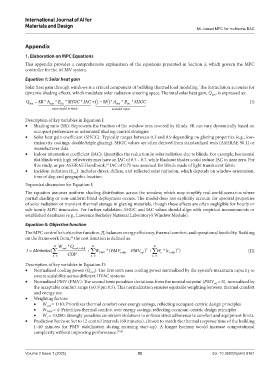
Solar heat gain through windows is a critical component of building thermal load modeling. The formulation accounts for
dynamic shading effects, which modulate solar radiation entering space. The total solar heat gain, Q , is expressed as:
win
E *
SHGC
1 SR
Q win SRA* win * E * SHGCIAC* (I)
*
A*
inc
inc
win
region shaded by blinds unshaded region
Description of key variables in Equation I:
• Shading ratio (SR): Represents the fraction of the window area covered by blinds. SR can vary dynamically based on
occupant preferences or automated shading control strategies
• Solar heat gain coefficient (SHGC): Typically ranges between 0.3 and 0.9 depending on glazing properties (e.g., low-
emissivity coatings, double/triple glazing). SHGC values are often derived from standardized tests (ASHRAE 90.1) or
manufacturer data
• Indoor attenuation coefficient (IAC): Quantifies the reduction in solar radiation due to blinds. For example, horizontal
slat blinds with high reflectivity may have an IAC of 0.5 – 0.7, while blackout shades could reduce IAC to near zero. For
33
this study, as per ASHRAE Handbook, IAC of 0.75 was assumed for blinds made of light translucent fabric
• Incident radiation (E ): Includes direct, diffuse, and reflected solar radiation, which depends on window orientation,
inc
time of day, and geographic location.
Expanded discussion for Equation I:
The equation assumes uniform shading distribution across the window, which may simplify real-world scenarios where
partial shading or non-uniform blind deployment occurs. The model does not explicitly account for spectral properties
of solar radiation or transient thermal storage in glazing materials, though these effects are often negligible for hourly or
sub-hourly MPC timescales. For further validation, SHGC and IAC values should align with empirical measurements or
established databases (e.g., Lawrence Berkeley National Laboratory’s Window Module).
Equation II: Objective function
The MPC controller’s objective function, JJ, balances energy efficiency, thermal comfort, and operational feasibility. Building
on the framework from, the cost function is defined as:
39
N W cool * Q cool tk t | N N
,
J Minimize( W PMV *( PMV t kt | PMMV ) W *( tk t| ) ) (II)
2
2
ref
k0 COP k0 k 0
Description of key variables in Equation II:
• Normalized cooling power (Q ): The first term uses cooling power normalized by the system’s maximum capacity to
cool
ensure scalability across different HVAC systems
• Normalized PMV (PMV): The second term penalizes deviations from the neutral setpoint (PMV = 0), normalized by
ref
the acceptable comfort range (±0.5\pm 0.5). This normalization ensures equitable weighting between thermal comfort
and energy use.
• Weighting factors:
• W cool = 1/10: Prioritizes thermal comfort over energy savings, reflecting occupant-centric design principles
• W PMV = 4: Prioritizes thermal comfort over energy savings, reflecting occupant-centric design principles
• W = 10,000: Strongly penalizes constraint violations to enforce strict adherence to comfort and equipment limits.
ϵ
• Prediction horizon: Set to 12 control intervals (60 minutes), chosen to match the thermal response time of the building
(~40 minutes for PMV stabilization during morning start-up). A longer horizon would increase computational
complexity without improving performance. 39,40
Volume 2 Issue 1 (2025) 52 doi: 10.36922/ijamd.8161

