


Page 61 - IJAMD-2-1
P. 61
International Journal of AI for
            Materials and Design
                                                                             Fatigue life prediction via contrastive learning


              Currently, with the development of advanced intelligent   life of 316L and 304 stainless steels, demonstrated strong
            algorithms, data-driven methods have been widely   generalization capabilities. Chen  et al.  proposed a
                                                                                                 28
            developed and applied in the field of material fatigue life   multiview neural network model incorporating frequency
            prediction. 11-18  From classical shallow machine learning   domain analysis. This model integrates convolutional
            algorithms to deep learning models based on neural   neural networks (CNN), long short-term memory
            networks, these methods have demonstrated excellent   networks, and FNet with frequency domain analysis  in
            performance in various fatigue-related problems. 19-24  Jiang   a parallel structure, extracting effective features from
            et al. proposed a physics-informed multilayer nested   the material loading path to predict fatigue life. Through
                25
            neural network framework, using stacking fault energy,   ablation experiments, the extrapolation capability of the
            strain amplitude, strain rate, and temperature as input   model was verified using specific test datasets. Zhang et al.
                                                                                                            29
            features. Physical constraints were embedded in the loss   used a SHapley Additive exPlanations-informed recursive
            function to ensure the model adhered to known physical   feature elimination method to identify key features in a
            laws. The performance of the model was validated on   multiaxial fatigue experiment dataset. Symbolic regression
            fatigue data of 316 stainless steel. Zhu et al.  developed   was  employed to  extract and  encapsulate expressions
                                                26
            a deep learning model called Multi-GAT (Multi-Graph   predicting fatigue life based on these salient features, which
            Attention Network) for predicting the high-cycle fatigue   were then integrated into the traditional mean squared
            (HCF) life of titanium alloys. This model is integrated   error (MSE). This significantly improved the predictive
            with an attention mechanism and uses a graph structure   accuracy of the model on the existing database.
            as the data structure, allowing the full consideration of
            relationships  between  samples.  This  approach  enables   In fatigue life prediction, constructing appropriate input
            the accurate prediction of HCF life for various titanium   features is crucial for improving the model’s predictive
            alloys using a limited number of sample data. Liao et al.    performance. 30-33  Simply using raw experimental features
                                                         27
            proposed a path-dependent adaptive physics-informed   as inputs may not lead to optimal results. To achieve
            neural network to address the non-proportionality caused   effective feature engineering, researchers have drawn
            by phase differences. The model embedded multiple   on various traditional empirical models, such as critical
            critical plane models into the loss function and achieved   plane models, 34,35  damage mechanics models, 36,37  and
            optimization through dynamic weight adjustment. Genetic   fracture mechanics models. 38,39  These empirical insights
            algorithms and a meta-learning framework were used to   help in selecting and designing more relevant features,
            optimize the weight hyperparameters. The meta-learning   which significantly enhance the model’s ability to predict
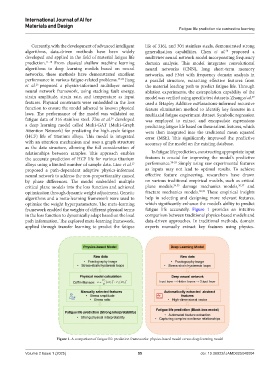
            framework enabled the weights of different physical terms   fatigue life accurately.  Figure  1 provides an intuitive
            in the loss function to dynamically adapt based on the load   comparison between traditional physics-based models and
            path information. The explored meta-learning framework,   data-driven approaches. In traditional methods, domain
            applied through transfer learning to predict the fatigue   experts manually extract key features using physics-


                         Figure 1. A comparison of fatigue life prediction frameworks: physics-based model versus deep learning model


            Volume 2 Issue 1 (2025)                         55                        doi: 10.36922/IJAMD025040004

